Couldn't have asked for a better opening night - apart from a full house. The cast were stunning, the techs amazing (particularly given they only arrived on Sunday) and of utmost importance - it worked!
It was the production of Macbeth I've always wanted to see, the script worked very well and the effects were great, but really the cast were what made it fly.
If you're in town you have to come and see them!!!!!
06 August 2008


02 August 2008
Four days to go
Well four days till we have an audience. The cast has done a brilliant job, they're ready to go and I am impressed with them.
The only issue is whether the costumes, lighting, sound and other effects and the cast are working together. Tomorrow we have all the costumes, the smoke, the smells, the props, and the curtains up, but getting the cast and the bits and pieces working together is my big worry.
There is much to do. I spent much of the afternoon hanging curtains, these are the 'set'. I also went to hang the gauze, which was a major effort and I discovered the way we intended to do it won't work.
Tomorrow we are without the stage manager and lighting operator for the morning and various cast have given me ultimatums about when they can start and finish.
What it seems is that it's harder and harder to get actors to rehearsals and to get techs and backstage people at all. Today people are working weekends and evenings and anyone with technical skills wants to be paid. Not having a set seemed to be one way to ensure that we could strike the set each night (as we have to) and save effort and energy.
Well the play looks good.
The only issue is whether the costumes, lighting, sound and other effects and the cast are working together. Tomorrow we have all the costumes, the smoke, the smells, the props, and the curtains up, but getting the cast and the bits and pieces working together is my big worry.
There is much to do. I spent much of the afternoon hanging curtains, these are the 'set'. I also went to hang the gauze, which was a major effort and I discovered the way we intended to do it won't work.
Tomorrow we are without the stage manager and lighting operator for the morning and various cast have given me ultimatums about when they can start and finish.
What it seems is that it's harder and harder to get actors to rehearsals and to get techs and backstage people at all. Today people are working weekends and evenings and anyone with technical skills wants to be paid. Not having a set seemed to be one way to ensure that we could strike the set each night (as we have to) and save effort and energy.
Well the play looks good.
15 July 2008
22 days till opening
First full run tonight. Much later than I would have hoped and not in the venue. The first half held together well, the from act 3 it looked much worse.
Still haven't seen any stage blood, don't know about many of the costumes, music .... oh and we still can't get the whole cast in one place at once.
On the plus side - the edits are working, the cast is strong, my flu has nearly passed.
M and Lady M are very strong. The relationships are excellent. The cast are of a very high qaulity all round. We have a new witch which requires bringing her up to speed with the play. But it's all good.
Still haven't seen any stage blood, don't know about many of the costumes, music .... oh and we still can't get the whole cast in one place at once.
On the plus side - the edits are working, the cast is strong, my flu has nearly passed.
M and Lady M are very strong. The relationships are excellent. The cast are of a very high qaulity all round. We have a new witch which requires bringing her up to speed with the play. But it's all good.
13 July 2008
24 days to go
We open in 24 days. That fills me with dread. We've still seen no costumes, no props and have no sound effects.
On the plus side despite another witch pulling out last week and one of the unnamed Lords having to pull out following a car accident as his leg is in plaster we have a full cast and the play is looking good.
We do have a gauze at last and I have resolved the issues around the staging. Also the lighting plan is being developed and same with special effects seem to be on track. Chanel is sorting out the music.
So provided no more problems arise we are on track.
This is almost the time when I wonder why it matters, why it's so hard and why oh why do we do this.
On the plus side despite another witch pulling out last week and one of the unnamed Lords having to pull out following a car accident as his leg is in plaster we have a full cast and the play is looking good.
We do have a gauze at last and I have resolved the issues around the staging. Also the lighting plan is being developed and same with special effects seem to be on track. Chanel is sorting out the music.
So provided no more problems arise we are on track.
This is almost the time when I wonder why it matters, why it's so hard and why oh why do we do this.
11 July 2008
Opening video for show - spoiler
The video has been created to open the show. It's supposed to look like a webvideo ....
http://www.vidcast.co.nz:80/VidCastPodCastProductionbyTandemVoiceBooth/Player/tabid/86/VideoId/202/Default.aspx
thanks to Tandem Studios for the talent and the production, to Scott Koorey for the music and to a distant cousin of William Shakespeare for the script.
http://www.vidcast.co.nz:80/VidCastPodCastProductionbyTandemVoiceBooth/Player/tabid/86/VideoId/202/Default.aspx
thanks to Tandem Studios for the talent and the production, to Scott Koorey for the music and to a distant cousin of William Shakespeare for the script.
10 July 2008
Script edits
I know I'm not the person to say this - but the edits rock. If anyone anywhere is looking to do a complete production of Macbeth and wants a 65min script - I have it!
22 June 2008
Rehearsal changes
Tuesday June 24 is now all of Act 1 (So witches etc needed now afterall)
Thursday 26 June is now Act 1 Sc4-7
Sunday 29 June - all are called with 2 to 2-20 only Malcolm, Macduff and Ross. 2:20 on a run through the whole play.
Thursday 26 June is now Act 1 Sc4-7
Sunday 29 June - all are called with 2 to 2-20 only Malcolm, Macduff and Ross. 2:20 on a run through the whole play.
Okay I take it back
After all my high sounding commentary in the posts 2 and 3 days ago I spent today's rehearsal simply blocking. There was nothing much else going on.
Rehearsal Sunday 29 June
I'm calling everyone for rehearsal at 2 pm. The rehearsal is at the theatre.
21 June 2008
Acting and direction
In the last post I mentioned Meisner, Stanislavsky and method. I'm not wanting to seem to be trendy or throwing around names of acting schools without understanding them so just a little here on what I meant. I know only a little about Strasberg, Meisner, Stansilavsky, Adler and some of the 20th century approaches to acting. And, for example, I'm not keen on apparently repititious meaningless exchanges as a way of learning to react (Meisner is well known for these exercises). At the level of theatre I work at we haven't time for weeks of exploration.
What is clear to me today is that if you are aware of modern theatre you can't help but be influenced by these schools and theories. The alternative is what I grew up with - the first few rehearsals are blocking (Stand here, move there, sit down, stand) followed by rehearsals which are tweaks of the first (sit in the middle of the line, put the gun there, say it with more passion).
What I want to see is something approaching genuine characters with motivations you can understand who move around for convincing reasons.
So I do use the blocking direction I grew up with but I have rudimentary and superficial but useful interpretations of these schools which inform my directorial style. I am drawn to what I understand from Meisner as the idea of trying to get actors in the now (what the repetition exercises are supposed to create). So that there performances are genuine in that they build from the energy and actors around them, and may differ from night to night but are motivations and reactions to others motivations. I think Meisner called this Affective Memory.
In Stanislavskly I like the idea of using imagination to understand where your character is and go with that. I mean for example neither of my actors playing Macbeth or Lady M have murdered or conspired to murder anyone as far as I am aware, so they need to imagine what it is like and go with that. Strasberg on the other hand (again as I understand it) wanted actors to draw on their own souls and psyches and reproduce their reactions to earlier events in their lives, or their psyches (I believe this is called emotion memory).
What I would say is each approach is useful for different actors. In other words where I can't get something out of an actor I may change approach. Some actors need to go back to when their pet rabbit died when they were 8 and use that to power their performance about losing a parent, another actor in the same role might simply imagine having lost his father to an assassin while a third may instead just get in the now and take on the enormity of what is being said.
I'm no expert. But I do like having a range of tools. As I eluded to earlier - our other issue is not having the luxury of spending 8 hours a day, every day, on this and not having necessarily the best material to work with. So when all else fails clever work-arounds (cheats) are really useful, that is if the actor can't stand without waving his hands around - get him to lean on things in every scene.
What is clear to me today is that if you are aware of modern theatre you can't help but be influenced by these schools and theories. The alternative is what I grew up with - the first few rehearsals are blocking (Stand here, move there, sit down, stand) followed by rehearsals which are tweaks of the first (sit in the middle of the line, put the gun there, say it with more passion).
What I want to see is something approaching genuine characters with motivations you can understand who move around for convincing reasons.
So I do use the blocking direction I grew up with but I have rudimentary and superficial but useful interpretations of these schools which inform my directorial style. I am drawn to what I understand from Meisner as the idea of trying to get actors in the now (what the repetition exercises are supposed to create). So that there performances are genuine in that they build from the energy and actors around them, and may differ from night to night but are motivations and reactions to others motivations. I think Meisner called this Affective Memory.
In Stanislavskly I like the idea of using imagination to understand where your character is and go with that. I mean for example neither of my actors playing Macbeth or Lady M have murdered or conspired to murder anyone as far as I am aware, so they need to imagine what it is like and go with that. Strasberg on the other hand (again as I understand it) wanted actors to draw on their own souls and psyches and reproduce their reactions to earlier events in their lives, or their psyches (I believe this is called emotion memory).
What I would say is each approach is useful for different actors. In other words where I can't get something out of an actor I may change approach. Some actors need to go back to when their pet rabbit died when they were 8 and use that to power their performance about losing a parent, another actor in the same role might simply imagine having lost his father to an assassin while a third may instead just get in the now and take on the enormity of what is being said.
I'm no expert. But I do like having a range of tools. As I eluded to earlier - our other issue is not having the luxury of spending 8 hours a day, every day, on this and not having necessarily the best material to work with. So when all else fails clever work-arounds (cheats) are really useful, that is if the actor can't stand without waving his hands around - get him to lean on things in every scene.
20 June 2008
Progress
One of the goals I set for myself for this production is to make the relationship between the Macbeths and their murder of Duncan plausible. This has been the underlying problem with nearly every production I have seen and most of the movies.
Last night working with the two actors I have for these roles I believe we made huge progress in cracking this dilemma. Both are fantastic actors who can convey subtlety as well as a broad range of emotions and motivations. I was momentarily scared as we worked on Act 1 Scene 5. Lady M was terrifying as these lines came to life:
"Thy letters have transported me beyond This ignorant present, and I feel now The future in the instant."
After we had finished I realised how much I owe to a newsgroup called Act Pro that I used to be a member of and to people, conversations and experiences which have developed my rudimentary understanding of Meisner, Stanislavsky and method. We had both Ms in the moment and alive to the motivation in the script and alive to the intentions of who they were and where they were going. Add to that drawing on their own personal experiences to make the moment alive with genuine emotion and we really were creating.
This is shaping up as the best production I have done. False hope / vaulting ambition? I too as a director am caught in the desire to create something based in authenticity - not just for the actors and the audience but also for me.
Last night working with the two actors I have for these roles I believe we made huge progress in cracking this dilemma. Both are fantastic actors who can convey subtlety as well as a broad range of emotions and motivations. I was momentarily scared as we worked on Act 1 Scene 5. Lady M was terrifying as these lines came to life:
"Thy letters have transported me beyond This ignorant present, and I feel now The future in the instant."
After we had finished I realised how much I owe to a newsgroup called Act Pro that I used to be a member of and to people, conversations and experiences which have developed my rudimentary understanding of Meisner, Stanislavsky and method. We had both Ms in the moment and alive to the motivation in the script and alive to the intentions of who they were and where they were going. Add to that drawing on their own personal experiences to make the moment alive with genuine emotion and we really were creating.
This is shaping up as the best production I have done. False hope / vaulting ambition? I too as a director am caught in the desire to create something based in authenticity - not just for the actors and the audience but also for me.
18 June 2008
Three different witches
The unfortunate exit from the cast of our witches (due to employment reasons) has focussed attention on the need for them to have individual personalities in some way. In other productions (to sound like a broken record) they are usually virtually indistinguishable. In the productions where there is an attempt to make them distinct there is often an older leader and a younger initiate. I'll work with Chanel, the AD, to see what we can do to give the 3 of them personalities.
15 June 2008
Macduff
One of the many things on my list to try and improve in this production over others I have seen is to make Macduff stand out. Normally he is invisible until he is tested and he leads the attack on the castle and kills Macbeth at the end. Banquo is always easy to spot, but the Malcolm, Macduff, Ross, Angus, Menteith, Lennox distinction is harder to make.
The Court Theatre here in Christchurch did a production set in Japan a few years ago, a tribute to Kurosaka I believe. In that production Macduff was given a ludicrous hat. Even then he didn't stand out that well.
In this production we're opting for Macduff as someone who is sees through the thrall and sees Macbeth for what he is. Maybe his goodness means he isn't (as easily) enchanted. That means he stands apart from all the others, perhaps is more modern in his dress, and at the beginning of the play looks askance at Macbeth. If he is also socially awkward it might explain why he isn't trusted by Malcolm and seems to have missed the victory banquet.
This standing aside positioning and scrutiny of Macbeth combined with a touch of a puritanical view of the world worked today in rehearsals, and the actor playing Macduff seems to be able to use this to make the character of Macduff strong and distinct.
We may still give him some distinct costuming - but no dumb hats.
The Court Theatre here in Christchurch did a production set in Japan a few years ago, a tribute to Kurosaka I believe. In that production Macduff was given a ludicrous hat. Even then he didn't stand out that well.
In this production we're opting for Macduff as someone who is sees through the thrall and sees Macbeth for what he is. Maybe his goodness means he isn't (as easily) enchanted. That means he stands apart from all the others, perhaps is more modern in his dress, and at the beginning of the play looks askance at Macbeth. If he is also socially awkward it might explain why he isn't trusted by Malcolm and seems to have missed the victory banquet.
This standing aside positioning and scrutiny of Macbeth combined with a touch of a puritanical view of the world worked today in rehearsals, and the actor playing Macduff seems to be able to use this to make the character of Macduff strong and distinct.
We may still give him some distinct costuming - but no dumb hats.
12 June 2008
School resource completed
Chanel and Andre have completed a curriculum school resource which is fantastic and the next step is to get it posted to schools!
It's more comprehensive and interesting than I had ever imagined!
It's more comprehensive and interesting than I had ever imagined!
10 June 2008
03 June 2008
First rehearsal
It's good when you sit with your cast for the first time and think 'this is going to be fantastic'.
I'm now trying to tune into the way in which people work best. I like to ask actors lots of questions about their characters, their motivations and their feelings at any given time, but this is not best for everyone.
The gold in this play is character motivations, and the decision to go with emphasising the supernatural elements gives a lot of scope for characters to talk about what they see versus what is going on, or what they fear. Not everything is as it seems. Most of the characters are led a merry dance by the main protagonists and characters relationship amd reaction to the evil that pervades the play is a great place to start.
I'm now trying to tune into the way in which people work best. I like to ask actors lots of questions about their characters, their motivations and their feelings at any given time, but this is not best for everyone.
The gold in this play is character motivations, and the decision to go with emphasising the supernatural elements gives a lot of scope for characters to talk about what they see versus what is going on, or what they fear. Not everything is as it seems. Most of the characters are led a merry dance by the main protagonists and characters relationship amd reaction to the evil that pervades the play is a great place to start.
31 May 2008
Read through and first cast get-together
I'm looking forward to getting the team together tomorrow - although there are one or two people who can't make it, notably the production co-ordinator Victoria. Although I've read everything and talked through a hell of a lot I still feel under-prepared.
27 May 2008

Cast selected for the play
With one or two exceptions I have a full cast. The posts now will include production issues and the processes we go through.
The normal story: 8 women capable of playing Lady Macbeth and 3 men capable of Macbeth. All of the witches I've cast could take on the role and I rejected a Lady Macbeth / Macbeth combination of 2 of the finest actors in town. However I am very pleased with the Macbeths have cast.
There were dramas in the auditons made worse as I haven't help proper auditions for 10 years having shoulder tapped since then. By the end of the day my brain was fried and judgement impaired. Also some really basic things about the next steps weren't conveyed to auditionees, by this I mean I forgot among other things to check their availability for the first read through.
Anyway as I like to sign my emails now - it's all good.
The normal story: 8 women capable of playing Lady Macbeth and 3 men capable of Macbeth. All of the witches I've cast could take on the role and I rejected a Lady Macbeth / Macbeth combination of 2 of the finest actors in town. However I am very pleased with the Macbeths have cast.
There were dramas in the auditons made worse as I haven't help proper auditions for 10 years having shoulder tapped since then. By the end of the day my brain was fried and judgement impaired. Also some really basic things about the next steps weren't conveyed to auditionees, by this I mean I forgot among other things to check their availability for the first read through.
Anyway as I like to sign my emails now - it's all good.
22 May 2008
Angus is a woman?
The male shortage has led me to think through my earlier idea of having one of the thanes as a woman because, really, she's a modern Scottish army officer. Eg Major Janet Angus. This has an added complication because Angus has taken on being killed by Macbeth in the penultimate scene instead of Young Siward. This creates problems around the 'man born of woman' dialogue. Anyway more thinking to do.
21 May 2008
The audition notice in the paper ....
has netted 1 audition enquiry as at 3 pm... more this evening I suspect.
20 May 2008
Script
I have the rehearsal copy ready to go!
It will need some changes depending on the actors I get - but it's very close.
It will need some changes depending on the actors I get - but it's very close.
Slots for auditions filling up
Anyone wanting an audition time should get in touch! The slots are filling fast.
Meanwhile the curse of Macbeth is my laptop has been crushed losing some vital files for the play in the process. Good news is I have got a copy of 'The Occult philosophy in the Elizabethan Age' by Frances Yates which is a good relevant read.
Meanwhile the curse of Macbeth is my laptop has been crushed losing some vital files for the play in the process. Good news is I have got a copy of 'The Occult philosophy in the Elizabethan Age' by Frances Yates which is a good relevant read.
14 May 2008
Audition enquiries suggest excellent auditions
I'm really impressed with some of the people who have contacted me about the auditions. Some because they're experienced, a couple because they're knowledgable, but most because they're keen.
05 May 2008
Our production
Auditions are 20 days away. What is good is that I am already impressed with the auditionees! Although I'm not sure we've got all our parts covered yet.
02 May 2008
Audition times
Auditions are on 25 May 2008, Elmwood Auditorium, Aikmans Rd, Christchurch.
- Macbeth and Lady Macbeth auditions from 9am
- Other characters 11 am on
- Witches from 2 pm
Anyone that can't make these times should contact me directly.
Macbeth and Lady Macbeth actors will be auditioned together with each actor getting to read with at least two others.
Witches will be auditioned in groups. The witches will be dancing so we’re looking for witches who can move.
The Poster - more or less

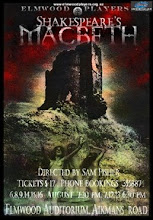
Well there was a poll on the site with all of 8 votes ... and it had no impact on the final poster! (what do you expect of website polls?) Anyway courtesy of Julian here is the poster which will be made more modest to keep schools happy.
27 April 2008
Teller's advice on bloody heads
This is a useful tip from Teller's Macbeth which I think I will take up for our production
Today we did a conference call about heads. In Shakespeare’s day, you’d go to work and see severed human heads on display on public structures to warn prospective crooks of the consequences of malfeasance.
Shakespeare introduces the dead Macbeth’s head right at the finale of the show. It was natural to Shakespeare. You wanna show a dead butcher? Bring out his head.
But in the modern theater, you don’t see a lot of heads. And for good reason. If the fake head (and, yes, I’m sorry; we’ll probably have to have to fake it, except maybe on the final performance) looks bad, you say, “How lame!” and it takes you out of the story. If it’s good, you say, “Wow, that’s a fine reproduction. I wonder how they cast it,” and you’re right out of the story. It’s a no-win situation.
So we’re looking for a way to get the horror without the distraction. At this point, we’re thinking of establishing the convention that severed heads are carried around in blood-soaked burlap bags. What’s nice about that is that this combines two awful images we’re seeing from the Middle East nowadays. We see terrorist prisoners with their heads in bags, and we see people being beheaded. Put ‘em together and you’ve got Macbeth.
Macbeth becomes a tyrant who rules by terror, so it makes sense he would display the heads (and maybe bodies) of uncooperative subjects.
http://www.pennandteller.com/03/coolstuff/tellerspeaks/telleressayheads.html
Today we did a conference call about heads. In Shakespeare’s day, you’d go to work and see severed human heads on display on public structures to warn prospective crooks of the consequences of malfeasance.
Shakespeare introduces the dead Macbeth’s head right at the finale of the show. It was natural to Shakespeare. You wanna show a dead butcher? Bring out his head.
But in the modern theater, you don’t see a lot of heads. And for good reason. If the fake head (and, yes, I’m sorry; we’ll probably have to have to fake it, except maybe on the final performance) looks bad, you say, “How lame!” and it takes you out of the story. If it’s good, you say, “Wow, that’s a fine reproduction. I wonder how they cast it,” and you’re right out of the story. It’s a no-win situation.
So we’re looking for a way to get the horror without the distraction. At this point, we’re thinking of establishing the convention that severed heads are carried around in blood-soaked burlap bags. What’s nice about that is that this combines two awful images we’re seeing from the Middle East nowadays. We see terrorist prisoners with their heads in bags, and we see people being beheaded. Put ‘em together and you’ve got Macbeth.
Macbeth becomes a tyrant who rules by terror, so it makes sense he would display the heads (and maybe bodies) of uncooperative subjects.
http://www.pennandteller.com/03/coolstuff/tellerspeaks/telleressayheads.html
Audition packs - here they are
Audition notes Macbeth – Elmwood Players 2008 – OVERVIEW
Performance Dates
o 6, 8 & 9 August at 7.30 pm
o 7,12 &13 August at 6.30 pm
o 14 – 16 August 7.30 pm
Auditions
25 May 2008
Elmwood Auditorium
Aikmans Road, Merivale
Times will be booked from 20 May, by appointment
· I will be auditioning Macbeth and Lady Macbeth actors together with each actor getting to read with at least two others.
· The witches will be auditioned in groups.
Above all I want people to give the type of audition that reflects the way they work… you can read up and prepare looking at background and the script OR turn up cold. Part of the audition is to find out how you like to work and what sort of actor you are.
For example I have worked with people who start rehearsals as blank canvasses and others who turn up to the first rehearsal with most of the character in place, with thinkers, intuitive actors, and others who are very physical in how they develop their characters.
Blog and production notes here - http://barcodemacbeth.blogspot.com/
Rehearsal times and dates
These have yet to be set but for principal roles 2 evenings and one session on the weekends during June, and early July moving to 3 evenings and one weekend till late July / early August.
Concept for the production
There is a continuum between performing Shakespeare exactly as written in the time in which it was set, and changing it to make it more accessible.
This production veers towards accessibility. Long scenes with very little information shared are being cut and some attempts are being made at the beginning toward making Macbeth more than just some Scottish guy hundreds of years ago. The audience needs to be with us and long clunky scenes with people questioning each other are not good entertainment.
This production will be reasonably traditional in most of the performance aspects, except that:
- There will be minimum set (chairs and a table), with black curtains, lighting, music and smoke
- There are significant cuts to reduce the performance time to 90 minutes
- Many smaller scenes with minor characters have been pruned
- Some scenes have been turned more into showing, rather than long speeches telling
- Following the ‘fair is foul and foul is fair’ themeing the witches are not going to be old hags but good looking and attractive and entirely evil
- Macbeth and Lady Macbeth are not going to be truly perfect heroic figures, rather having strengths, as they are often played. As well as the weaknesses of vaulting ambition –
o Macbeth is a great warrior but off the battlefield he is easily led and perhaps really doesn’t get how court politics work. This satisfies the imagery of not fitting the clothing of being King and explains why he never resorts to diplomacy to secure his throne.
o Lady Macbeth is very ambitious but small minded and shrewish toward her husband (this is demonstrated in the ‘screw your courage to the sticking place’ speech) and really she can’t foresee the costs of her urgings – perhaps seeing the short term goal but isn’t smart enough to see what will happen if you kill the King.
These basic characterisations also tend to support the idea that Macbeth has no use for Lady Macbeth after the Banquo’s ghost scene – he has just resorted to battlefield tactics of killing everything and she has nothing more to offer.
Another twist here is it might be interesting if the witches or Hecate are Lady Macbeth’s servants.
- The start and end of the play are set in contemporary times, Macbeth falls under the witches spells and so experiences the rest of the play as if it were circa 800 BC.
Macbeth
Audition notes Macbeth – Elmwood Players 2008 – Macbeth
Background
Macbeth is a great general and warrior. This is his thing – he is ferocious, fearless and an inspiring field commander.
Usually he is played as a great heroic character but with vaulting ambition, and power lust (and perhaps his wife) as his fatal weaknesses.
In this production we’re taking a harder look at why this ‘vaulting ambition’ leads to a bloodthirsty and insane coup d’etat betraying and murdering his leader, his best friend and destroying his country.
The line we will take is that he is a great general, but not a great politician. In fact off the battlefield he really is ‘in borrow’d clothes’. He is not up to being King. That’s peharps why Duncan didn’t make him Cumberland (crown prince).
His level of intelligence is up to the actor. Insightful soliloquy’s do not necessarily mean he’s bright.
The murders after Duncan show a Macbeth who falls back on what he knows- violent bloodshed – he turns the Kingdom into a battlefield because that’s what he understands.
The Elmwood Macbeth will be a mostly decent but flawed general who is perhaps reminiscent of a great sportsman who just doesn’t get the politics around his code.
So why does he kill Duncan?
· Yes he did think he should be King – he doesn’t know his limitations
· The witches cast a spell on him (a thrall) – which alters his perceptions
· Lady Macbeth is more ambitious than he is and is goading and pushing him
· He’s weak
The audition
The audition will involve – working with 2 auditionees for the role of Lady Macbeth (LM)
1. Some dialogue and movement with an auditionee for LM
2. A soliloquy
3. A discussion on how you like to work, and your views on the character and the play
4. The dialogue again with another actor as LM
Soliliquys - 2 to choose from:
Is this a dagger which I see before me,The handle toward my hand? Come, let me clutch thee.I have thee not, and yet I see thee still.Art thou not, fatal vision, sensibleTo feeling as to sight? or art thou butA dagger of the mind, a false creation,Proceeding from the heat-oppressed brain?I see thee yet, in form as palpableAs this which now I draw.Mine eyes are made the fools o' the other senses,Or else worth all the rest; I see thee still,And on thy blade and dudgeon gouts of blood,Which was not so before. There's no such thing:It is the bloody business which informsThus to mine eyes.
A bell rings
I go, and it is done; the bell invites me.Hear it not, Duncan; for it is a knellThat summons thee to heaven or to hell.
Or
I have lived long enough: my way of lifeIs fall'n into the sear, the yellow leaf;And that which should accompany old age,As honour, love, obedience, troops of friends,I must not look to have; but, in their stead,Curses, not loud but deep, mouth-honour, breath,Which the poor heart would fain deny, and dare not.
Dialogue
Enter LADY MACBETH
MACBETH
How now! what news?
LADY MACBETH
He has almost supp'd: why have you left the chamber?
MACBETH
Hath he ask'd for me?
LADY MACBETH
Know you not he has?
MACBETH
We will proceed no further in this business:He hath honour'd me of late; and I have boughtGolden opinions from all sorts of people,Which would be worn now in their newest gloss,Not cast aside so soon.
LADY MACBETH
Was the hope drunkWherein you dress'd yourself? hath it slept since?And wakes it now, to look so green and paleAt what it did so freely? From this timeSuch I account thy love. Art thou afeardTo be the same in thine own act and valourAs thou art in desire? Wouldst thou have thatWhich thou esteem'st the ornament of life,And live a coward in thine own esteem,Letting 'I dare not' wait upon 'I would,'Like the poor cat i' the adage?
MACBETH
Prithee, peace:I dare do all that may become a man;Who dares do more is none.
LADY MACBETH
What beast was't, then,That made you break this enterprise to me?When you durst do it, then you were a man;And, to be more than what you were, you wouldBe so much more the man. Nor time nor placeDid then adhere, and yet you would make both:They have made themselves, and that their fitness nowDoes unmake you. I have given suck, and knowHow tender 'tis to love the babe that milks me:I would, while it was smiling in my face,Have pluck'd my nipple from his boneless gums,And dash'd the brains out, had I so sworn as youHave done to this.
MACBETH
If we should fail?
LADY MACBETH
We fail!But screw your courage to the sticking-place,And we'll not fail. When Duncan is asleep--Whereto the rather shall his day's hard journeySoundly invite him--his two chamberlainsWill I with wine and wassail so convinceThat memory, the warden of the brain,Shall be a fume, and the receipt of reasonA vessel only: when in swinish sleepTheir drenched natures lie as in a death,What cannot you and I perform uponThe unguarded Duncan? what not put uponHis spongy officers, who shall bear the guiltOf our great quell?
MACBETH
Bring forth men-children only;For thy undaunted mettle should composeNothing but males. Will it not be received,When we have mark'd with blood those sleepy twoOf his own chamber and used their very daggers,That they have done't?
LADY MACBETH
Who dares receive it other,As we shall make our griefs and clamour roarUpon his death?
MACBETH
I am settled, and bend upEach corporal agent to this terrible feat.Away, and mock the time with fairest show:False face must hide what the false heart doth know.
Lady Macbeth
Audition notes Macbeth – Elmwood Players 2008 – Lady Macbeth
Background
Lady Macbeth is arguably the greatest female Shakespearean role.
Usually she is played with one of 3 variants –
1 Strong and ruthless, dominating her husband
2 As very much in love and weaker but who makes herself strong to do what she thinks her husband really wants
3 As equal to her husband but trying to work with him to achieve greatness, partly out of her own ambition and partly just being in partnership with him.
In this production we’re taking a harder look at both her and Macbeth to understand why they embark on a bloodthirsty and insane coup d’etat betraying and murdering the King and plunging the country into terror and confusion.
Just because other women’s roles in Shakespeare aren’t great is no reason to make her dominating and strong unless we really believe she is. Although many people have introduced historical detail behind the real Lady Macbeth this isn’t that relevant to the script.
So why does she urge Macbeth to, and go ahead with, killing Duncan? My answers for discussion are:
· She is very ambitious and wants them to be King and Queen
· Her ambition outweighs her commonsense and ability to understand the consequences of her actions
· The witches cast a spell on her and her husband
The audition
The audition will involve – working with 2 auditionees for the role of Macbeth
1. Some dialogue and movement with an auditionee for Macbeth
2. A soliloquy
3. A discussion on how you like to work, and your views on the character and the play
4. The dialogue again with another actor as Macbeth
Soliliquys - 2 to choose from:
The raven himself is hoarseThat croaks the fatal entrance of DuncanUnder my battlements. Come, you spiritsThat tend on mortal thoughts, unsex me here,And fill me from the crown to the toe top-fullOf direst cruelty! make thick my blood;Stop up the access and passage to remorse,That no compunctious visitings of natureShake my fell purpose, nor keep peace betweenThe effect and it! Come to my woman's breasts,And take my milk for gall, you murdering ministers,Wherever in your sightless substancesYou wait on nature's mischief! Come, thick night,And pall thee in the dunnest smoke of hell,That my keen knife see not the wound it makes,Nor heaven peep through the blanket of the dark,To cry 'Hold, hold!'
LADY MACBETH
Yet here's a spot.
Out, damned spot! out, I say!--One: two: why,then, 'tis time to do't.--Hell is murky!--Fie, mylord, fie! a soldier, and afeard? What need wefear who knows it, when none can call our power toaccount?--Yet who would have thought the old manto have had so much blood in him.
The thane of Fife had a wife: where is she now?--What, will these hands ne'er be clean?--No more o'that, my lord, no more o' that: you mar all withthis starting.
Here's the smell of the blood still: all theperfumes of Arabia will not sweeten this littlehand. Oh, oh, oh!
Dialogue
Enter LADY MACBETH
MACBETH
How now! what news?
LADY MACBETH
He has almost supp'd: why have you left the chamber?
MACBETH
Hath he ask'd for me?
LADY MACBETH
Know you not he has?
MACBETH
We will proceed no further in this business:He hath honour'd me of late; and I have boughtGolden opinions from all sorts of people,Which would be worn now in their newest gloss,Not cast aside so soon.
LADY MACBETH
Was the hope drunkWherein you dress'd yourself? hath it slept since?And wakes it now, to look so green and paleAt what it did so freely? From this timeSuch I account thy love. Art thou afeardTo be the same in thine own act and valourAs thou art in desire? Wouldst thou have thatWhich thou esteem'st the ornament of life,And live a coward in thine own esteem,Letting 'I dare not' wait upon 'I would,'Like the poor cat i' the adage?
MACBETH
Prithee, peace:I dare do all that may become a man;Who dares do more is none.
LADY MACBETH
What beast was't, then,That made you break this enterprise to me?When you durst do it, then you were a man;And, to be more than what you were, you wouldBe so much more the man. Nor time nor placeDid then adhere, and yet you would make both:They have made themselves, and that their fitness nowDoes unmake you. I have given suck, and knowHow tender 'tis to love the babe that milks me:I would, while it was smiling in my face,Have pluck'd my nipple from his boneless gums,And dash'd the brains out, had I so sworn as youHave done to this.
MACBETH
If we should fail?
LADY MACBETH
We fail!But screw your courage to the sticking-place,And we'll not fail. When Duncan is asleep--Whereto the rather shall his day's hard journeySoundly invite him--his two chamberlainsWill I with wine and wassail so convinceThat memory, the warden of the brain,Shall be a fume, and the receipt of reasonA vessel only: when in swinish sleepTheir drenched natures lie as in a death,What cannot you and I perform uponThe unguarded Duncan? what not put uponHis spongy officers, who shall bear the guiltOf our great quell?
MACBETH
Bring forth men-children only;For thy undaunted mettle should composeNothing but males. Will it not be received,When we have mark'd with blood those sleepy twoOf his own chamber and used their very daggers,That they have done't?
LADY MACBETH
Who dares receive it other,As we shall make our griefs and clamour roarUpon his death?
MACBETH
I am settled, and bend upEach corporal agent to this terrible feat.Away, and mock the time with fairest show:False face must hide what the false heart doth know.
The witches
Audition notes Macbeth – Elmwood Players 2008 – Witches
Background
When people think of Macbeth usually the witches are one of the first things they think of. Waiting outside to see productions of the play I have discussed with people how the witches will be played.
The key questions around any production and the witches are:
· Do they really enthral Macbeth?
· Are they just a prompt for Macbeth?
This production goes for real magic.
Usually the witches are played as hags – in this production we’re going to take the ‘fair is foul and foul is fair’ and apply it by making the witches physically attractive and internally very ugly. On the production blog is a music video with the proposed style of the dresses.
Also these witches will be dancing so we’re looking for witches who can move. The first scene sees the witches coming out of a rave tanked up and full of party pills – they then enthral Macbeth and he plunges into a nightmare which he experiences as circa 800 AD.
At various points in the play where really awful things are happening the witches will never be far away and having a great time – and they may be Lady Macbeth’s attendants (which would explain an awful lot).
The audition
The audition will involve – working with 2 other auditionees for the witches
1. Some dialogue and movement
2. A discussion on how you like to work, and your views on the characters and the play
Dialogue
First Witch
Thrice the brinded cat hath mew'd.
Second Witch
Thrice and once the hedge-pig whined.
Third Witch
Harpier cries 'Tis time, 'tis time.
First Witch
Round about the cauldron go;In the poison'd entrails throw.Toad, that under cold stoneDays and nights has thirty-oneSwelter'd venom sleeping got,Boil thou first i' the charmed pot.
ALL
Double, double toil and trouble;Fire burn, and cauldron bubble.
Second Witch
Fillet of a fenny snake,In the cauldron boil and bake;Eye of newt and toe of frog,Wool of bat and tongue of dog,Adder's fork and blind-worm's sting,Lizard's leg and owlet's wing,For a charm of powerful trouble,Like a hell-broth boil and bubble.
ALL
Double, double toil and trouble;Fire burn and cauldron bubble.
Third Witch
Scale of dragon, tooth of wolf,Witches' mummy, maw and gulfOf the ravin'd salt-sea shark,Root of hemlock digg'd i' the dark,Liver of blaspheming Jew,Gall of goat, and slips of yewSilver'd in the moon's eclipse,Nose of Turk and Tartar's lips,Finger of birth-strangled babeDitch-deliver'd by a drab,Make the gruel thick and slab:Add thereto a tiger's chaudron,For the ingredients of our cauldron.
ALL
Double, double toil and trouble;Fire burn and cauldron bubble.
Second Witch
Cool it with a baboon's blood,Then the charm is firm and good.
By the pricking of my thumbs,Something wicked this way comes.Open, locks,Whoever knocks!
Duncan
Audition notes Macbeth – Elmwood Players 2008 – Duncan
Background
Duncan is the perfect monarch, usually played as ‘older’.
Gravitas / authority will be key to this part. This usually means taller and distinguished.
The dialogue has been cut from the full version of the play.
The actor can double for other parts.
The audition
The audition will involve –
1. Some dialogue
2. A discussion on how you like to work, and your views on the characters and the play
Dialogue
SCENE IV. Forres. The palace.
Flourish. Enter DUNCAN, MALCOLM, and Attendants
DUNCAN
Is execution done on Cawdor? Are notThose in commission yet return'd?
MALCOLM
My liege,They are not yet come back. But I have spokeWith one that saw him die: who did reportThat very frankly he confess'd his treasons,Implored your highness' pardon and set forthA deep repentance: nothing in his lifeBecame him like the leaving it; he diedAs one that had been studied in his deathTo throw away the dearest thing he owed,As 'twere a careless trifle.
DUNCAN
There's no artTo find the mind's construction in the face:He was a gentleman on whom I builtAn absolute trust.
Enter MACBETH, BANQUO, ROSS
O worthiest cousin!Would thou hadst less deserved,That the proportion both of thanks and paymentMight have been mine! only I have left to say,More is thy due than more than all can pay.
MACBETH
The service and the loyalty I owe,In doing it, pays itself. Your highness' partIs to receive our duties; and our dutiesAre to your throne and state children and servants,Which do but what they should, by doing every thingSafe toward your love and honour.
DUNCAN
Welcome hither:Noble Banquo,That hast no less deserved.
My plenteous joys,Wanton in fulness, seek to hide themselvesIn drops of sorrow.
Sons, kinsmen, thanes,And you whose places are the nearest, knowWe will establish our estate uponOur eldest, Malcolm, whom we name hereafterThe Prince of Cumberland; which honour mustNot unaccompanied invest him only,But signs of nobleness, like stars, shall shineOn all deservers. From hence to Inverness,And bind us further to you.
MACBETH
[Aside] The Prince of Cumberland! that is a stepOn which I must fall down, or else o'erleap,For in my way it lies. Stars, hide your fires;Let not light see my black and deep desires:The eye wink at the hand; yet let that be,Which the eye fears, when it is done, to see.
The rest is labour, which is not used for you:I'll be myself the harbinger and make joyfulThe hearing of my wife with your approach;So humbly take my leave.
DUNCAN
My worthy Cawdor!
Exit
DUNCAN
True, worthy Banquo; he is full so valiant,And in his commendations I am fed;It is a banquet to me. Let's after him,Whose care is gone before to bid us welcome:It is a peerless kinsman.
Flourish. Exeunt
The Porter
Audition notes Macbeth – Elmwood Players 2008 – Porter
Background
The porter is often seen as the ‘light relief’ in Macbeth.
He is clearly a metaphor for the porter to the gates of hell and I suppose that porter would need a sense of humour.
I have no firm idea of how this part should be played but it is a great part for someone of have fun with.
The actor may be asked to double – perhaps for the doctor or be the same person as Seyton who appears later.
The audition
The audition will involve –
1. Some dialogue
2. A discussion on how you like to work, and your views on the characters and the play
Dialogue
Porter
Here's a knocking indeed! If aman were porter of hell-gate, he should haveold turning the key.
Knocking within
Knock,knock, knock! Who's there, i' the name ofBeelzebub?
Knocking within
Knock,knock! Who's there, in the other devil'sname? Faith, here's an equivocator, that couldswear in both the scales against either scale;who committed treason enough for God's sake,yet could not equivocate to heaven: O, comein, equivocator.
Knocking within
Knock,knock, knock! Who's there?
Knocking within
Knock, knock; What are you? Butthis place is too cold for hell. I'll devil-porterit no further:
Knocking within
Anon, anon! I pray you.
Opens the gate
Enter MACDUFF and Ross
MACDUFF
Was it so late, friend, ere you went to bed,That you do lie so late?
Porter
'Faith sir, we were carousing till thesecond cock: and drink, sir, is a greatprovoker of three things.
MACDUFF
What three things does drink especially provoke?
Porter
Marry, sir, nose-painting, sleep, andurine. Lechery, sir, it provokes, and unprovokes;it provokes the desire, but it takesaway the performance: therefore, much drinkmay be said to be an equivocator with lechery:it makes him, and it mars him; it setshim on, and it takes him off; it persuades him,and disheartens him; makes him stand to, andnot stand to; in conclusion, equivocates himin a sleep, and, giving him the lie, leaves him.
MACDUFF
I believe drink gave thee the lie last night.
Porter
That it did, sir
All other parts
Audition notes Macbeth – Elmwood Players 2008 – Miscellaneous parts
Background
The Elmwood production of Macbeth will be both traditional and modern with the play starting in modern times and moving into circa 800 AD.
We will be working to get Macbeth and Lady Macbeth’s motivation as plausible other than them being very heroic but with a vaulting ambition that makes them kill Duncan and leads to chaos, bloodshed and evil.
The cast will operate as a team with some doubling of roles. There have been many cuts Macduff, Banquo, Malcolm, Ross and Angus are still substantial but many other miscellaneous thanes have vanished. Depending on the cast one or two can be retrieved by reclaiming their lines. Seyton is now the chief murderer.
The Old Man, young Macduff, Fleance, Donalbain, both Siwards, Menteith, the English Doctor, and some of the murderers have gone.
Given the setting of the play there is room for a female thane (the idea is that Macbeth is a contemporary military commander experiencing a dark ages nightmare so a woman General or Colonel is possible).
Lady Macduff, the Gentlewoman and Hecate now only have a few lines. These combined with other servants leaves room for doubling roles. Some scenes have been cut so that the play will be showing people rather than telling them what is happening.
There will be little set; black drapes, a table and some chairs, smoke and light. Oh and lots of blood.
The audition
The audition will involve – working with other auditionees:
1. Some dialogue and movement
2. A discussion on how you like to work, and your views on the characters and the play
Dialogue and soliloquy’s
BANQUO
What are theseSo wither'd and so wild in their attire,That look not like the inhabitants o' the earth,And yet are on't? Live you? or are you aughtThat man may question? You seem to understand me,By each at once her chappy finger layingUpon her skinny lips: you should be women,And yet your beards forbid me to interpretThat you are so.
********
ROSS
Good morrow, noble sir.
MACBETH
Good morrow, both.
MACDUFF
Is the king stirring, worthy thane?
MACBETH
Not yet.
MACDUFF
He did command me to call timely on him:I have almost slipp'd the hour.
MACBETH
I'll bring you to him.
MACDUFF
I know this is a joyful trouble to you;But yet 'tis one.
MACBETH
The labour we delight in physics pain.This is the door.
MACDUFF
I'll make so bold to call,For 'tis my limited service.
Exit
ROSS
Goes the king hence to-day?
MACBETH
He does: he did appoint so.
ROSS
The night has been unruly: where we lay,Our chimneys were blown down; and, as they say,Lamentings heard i' the air; strange screams of death,And prophesying with accents terribleOf dire combustion and confused events
MACBETH
'Twas a rough night.
Re-enter MACDUFF
MACDUFF
O horror, horror, horror! Tongue nor heartCannot conceive nor name thee!
MACBETH / ROSS
What's the matter?
MACDUFF
Confusion now hath made his masterpiece!Most sacrilegious murder hath broke opeThe Lord's anointed temple, and stole thenceThe life o' the building!
MACBETH
What is 't you say? the life?
ROSS
Mean you his majesty?
MACDUFF
Approach the chamber, and destroy your sightSee, and then speak yourselves.
Exeunt MACBETH and ROSS
Awake, awake!Ring the alarum-bell. Murder and treason!Awake!Shake off this downy sleep, death's counterfeit,And look on death itself! up, up, and seeThe great doom's image! Malcolm! Banquo!As from your graves rise up, and walk like sprites,To countenance this horror! Ring the bell.
********
SCENE IV. Outside Macbeth's castle.
Enter ROSS and MACDUFF
ROSS
Is't known who did this more than bloody deed?
MACDUFF
Those that Macbeth hath slain.
ROSS
Alas, the day!What good could they pretend?
MACDUFF
They were suborn'd:Malcolm the king's son,Is stol'n away and fled; which puts upon himSuspicion of the deed.
ROSS
'Gainst nature still!Then 'tis most likeThe sovereignty will fall upon Macbeth.
MACDUFF
He is already named, and gone to SconeTo be invested.
ROSS
Will you to Scone?
MACDUFF
No, cousin, I'll to Fife.
ROSS
Well, I will thither.
MACDUFF
Well, may you see things well done there: adieu!Lest our old robes sit easier than our new!
ROSS
Farewell, cousin
********
HECATE
Have I not reason, beldams as you are,Saucy and overbold? How did you dareTo trade and traffic with MacbethIn riddles and affairs of death;And I, the mistress of your charms,The close contriver of all harms,Was never call'd to bear my part,Or show the glory of our art?And, which is worse, all you have doneHath been but for a wayward son,Spiteful and wrathful, who, as others do,Loves for his own ends, not for you.But make amends now: get you gone.
********
MACDUFF
Let us ratherHold fast the mortal sword, and like good menBestride our down-fall'n birthdom: each new morn
MALCOLM
Perchance even there where I did find my doubts.Why in that rawness left you wife and child,Those precious motives, those strong knots of love,Without leave-taking? I pray you,
MACDUFF
Bleed, bleed, poor country!Great tyranny! lay thou thy basis sure,For goodness dare not cheque thee: wear thouthy wrongs;The title is affeer'd! Fare thee well, lord:I would not be the villain that thou think'stFor the whole space that's in the tyrant's grasp,And the rich East to boot.
MALCOLM
Be not offended:I speak not as in absolute fear of you.I think our country sinks beneath the yoke;It weeps, it bleeds; and each new day a gashIs added to her wounds.
MACDUFF
Not in the legionsOf horrid hell can come a devil more damn'dIn evils to top Macbeth.
MALCOLM
I grant him bloody,
********
MACDUFF
See, who comes here?
MALCOLM
My countryman; but yet I know him not.
MACDUFF
My ever-gentle cousin, welcome hither.
ROSS
Sir.
MACDUFF
Stands Scotland where it did?
ROSS
Alas, poor country!Almost afraid to know itself. It cannotBe call'd our mother, but our grave; where nothing,But who knows nothing, is once seen to smile;Where sighs and groans and shrieks that rend the airAre made, not mark'd; where violent sorrow seemsA modern ecstasy; the dead man's knellIs there scarce ask'd for who; and good men's livesExpire before the flowers in their caps,Dying or ere they sicken.
MACDUFF
O, relationToo nice, and yet too true!
MALCOLM
What's the newest grief?
ROSS
That of an hour's age doth hiss the speaker:Each minute teems a new one.
MACDUFF
How does my wife?
ROSS
Why, well.
MACDUFF
And all my children?
ROSS
Well too.
MACDUFF
The tyrant has not batter'd at their peace?
ROSS
No; they were well at peace when I did leave 'em.
Now is the time of help; your eye in ScotlandWould create soldiers, make our women fight,To doff their dire distresses.
MALCOLM
Be't their comfortWe are coming thither: gracious England hathLent us good Siward and ten thousand men;An older and a better soldier noneThat Christendom gives out.
ROSS
Would I could answerThis comfort with the like! But I have wordsThat would be howl'd out in the desert air,Where hearing should not latch them.
MACDUFF
What concern they?The general cause? or is it a fee-griefDue to some single breast?
ROSS
No mind that's honestBut in it shares some woe; though the main partPertains to you alone.
MACDUFF
If it be mine,Keep it not from me, quickly let me have it.
ROSS
Let not your ears despise my tongue for ever,Which shall possess them with the heaviest soundThat ever yet they heard.
MACDUFF
I guess at it.
ROSS
Your castle is surprised; your wife and babesSavagely slaughter'd: to relate the manner,Were, on the quarry of these murder'd deer,To add the death of you.
MALCOLM
Merciful heaven!Whispers the o'er-fraught heart and bids it break.
MACDUFF
My children too?
ROSS
Wife, children, servants, allThat could be found.
MACDUFF
And I must be from thence!My wife kill'd too?
ROSS
I have said.
MALCOLM
Be comforted:Let's make us medicines of our great revenge,To cure this deadly grief.
MACDUFF
He has no children. All my pretty ones?Did you say all? O hell-kite! All?At one fell swoop?
MALCOLM
Be this the whetstone of your sword: let griefConvert to anger; blunt not the heart, enrage it.
Come, go we to the king; our power is ready;Our lack is nothing but our leave; MacbethIs ripe for shaking, and the powers abovePut on their instruments. Receive what cheer you may:The night is long that never finds the day.
********
Doctor
I have two nights watched with you, but can perceiveno truth in your report. When was it she last walked?
Gentlewoman
Since his majesty went into the field, I have seenher rise from her bed, throw her night-gown uponher, unlock her closet, take forth paper, fold it,write upon't, read it, afterwards seal it, and againreturn to bed; yet all this while in a most fast sleep.
Doctor
A great perturbation in nature, to receive at oncethe benefit of sleep, and do the effects ofwatching! In this slumbery agitation, besides herwalking and other actual performances, what, at anytime, have you heard her say?
Gentlewoman
That, sir, which I will not report after her.
Doctor
You may to me: and 'tis most meet you should.
Gentlewoman
Neither to you nor any one; having no witness toconfirm my speech.
Enter LADY MACBETH, with a taper
Lo you, here she comes! This is her very guise;and, upon my life, fast asleep. Observe her; stand close.
Doctor
How came she by that light?
Gentlewoman
Why, it stood by her: she has light by hercontinually; 'tis her command.
Doctor
You see, her eyes are open.
Gentlewoman
Ay, but their sense is shut.
Doctor
What is it she does now? Look, how she rubs her hands.
Gentlewoman
It is an accustomed action with her, to seem thuswashing her hands: I have known her continue inthis a quarter of an hour.
Performance Dates
o 6, 8 & 9 August at 7.30 pm
o 7,12 &13 August at 6.30 pm
o 14 – 16 August 7.30 pm
Auditions
25 May 2008
Elmwood Auditorium
Aikmans Road, Merivale
Times will be booked from 20 May, by appointment
· I will be auditioning Macbeth and Lady Macbeth actors together with each actor getting to read with at least two others.
· The witches will be auditioned in groups.
Above all I want people to give the type of audition that reflects the way they work… you can read up and prepare looking at background and the script OR turn up cold. Part of the audition is to find out how you like to work and what sort of actor you are.
For example I have worked with people who start rehearsals as blank canvasses and others who turn up to the first rehearsal with most of the character in place, with thinkers, intuitive actors, and others who are very physical in how they develop their characters.
Blog and production notes here - http://barcodemacbeth.blogspot.com/
Rehearsal times and dates
These have yet to be set but for principal roles 2 evenings and one session on the weekends during June, and early July moving to 3 evenings and one weekend till late July / early August.
Concept for the production
There is a continuum between performing Shakespeare exactly as written in the time in which it was set, and changing it to make it more accessible.
This production veers towards accessibility. Long scenes with very little information shared are being cut and some attempts are being made at the beginning toward making Macbeth more than just some Scottish guy hundreds of years ago. The audience needs to be with us and long clunky scenes with people questioning each other are not good entertainment.
This production will be reasonably traditional in most of the performance aspects, except that:
- There will be minimum set (chairs and a table), with black curtains, lighting, music and smoke
- There are significant cuts to reduce the performance time to 90 minutes
- Many smaller scenes with minor characters have been pruned
- Some scenes have been turned more into showing, rather than long speeches telling
- Following the ‘fair is foul and foul is fair’ themeing the witches are not going to be old hags but good looking and attractive and entirely evil
- Macbeth and Lady Macbeth are not going to be truly perfect heroic figures, rather having strengths, as they are often played. As well as the weaknesses of vaulting ambition –
o Macbeth is a great warrior but off the battlefield he is easily led and perhaps really doesn’t get how court politics work. This satisfies the imagery of not fitting the clothing of being King and explains why he never resorts to diplomacy to secure his throne.
o Lady Macbeth is very ambitious but small minded and shrewish toward her husband (this is demonstrated in the ‘screw your courage to the sticking place’ speech) and really she can’t foresee the costs of her urgings – perhaps seeing the short term goal but isn’t smart enough to see what will happen if you kill the King.
These basic characterisations also tend to support the idea that Macbeth has no use for Lady Macbeth after the Banquo’s ghost scene – he has just resorted to battlefield tactics of killing everything and she has nothing more to offer.
Another twist here is it might be interesting if the witches or Hecate are Lady Macbeth’s servants.
- The start and end of the play are set in contemporary times, Macbeth falls under the witches spells and so experiences the rest of the play as if it were circa 800 BC.
Macbeth
Audition notes Macbeth – Elmwood Players 2008 – Macbeth
Background
Macbeth is a great general and warrior. This is his thing – he is ferocious, fearless and an inspiring field commander.
Usually he is played as a great heroic character but with vaulting ambition, and power lust (and perhaps his wife) as his fatal weaknesses.
In this production we’re taking a harder look at why this ‘vaulting ambition’ leads to a bloodthirsty and insane coup d’etat betraying and murdering his leader, his best friend and destroying his country.
The line we will take is that he is a great general, but not a great politician. In fact off the battlefield he really is ‘in borrow’d clothes’. He is not up to being King. That’s peharps why Duncan didn’t make him Cumberland (crown prince).
His level of intelligence is up to the actor. Insightful soliloquy’s do not necessarily mean he’s bright.
The murders after Duncan show a Macbeth who falls back on what he knows- violent bloodshed – he turns the Kingdom into a battlefield because that’s what he understands.
The Elmwood Macbeth will be a mostly decent but flawed general who is perhaps reminiscent of a great sportsman who just doesn’t get the politics around his code.
So why does he kill Duncan?
· Yes he did think he should be King – he doesn’t know his limitations
· The witches cast a spell on him (a thrall) – which alters his perceptions
· Lady Macbeth is more ambitious than he is and is goading and pushing him
· He’s weak
The audition
The audition will involve – working with 2 auditionees for the role of Lady Macbeth (LM)
1. Some dialogue and movement with an auditionee for LM
2. A soliloquy
3. A discussion on how you like to work, and your views on the character and the play
4. The dialogue again with another actor as LM
Soliliquys - 2 to choose from:
Is this a dagger which I see before me,The handle toward my hand? Come, let me clutch thee.I have thee not, and yet I see thee still.Art thou not, fatal vision, sensibleTo feeling as to sight? or art thou butA dagger of the mind, a false creation,Proceeding from the heat-oppressed brain?I see thee yet, in form as palpableAs this which now I draw.Mine eyes are made the fools o' the other senses,Or else worth all the rest; I see thee still,And on thy blade and dudgeon gouts of blood,Which was not so before. There's no such thing:It is the bloody business which informsThus to mine eyes.
A bell rings
I go, and it is done; the bell invites me.Hear it not, Duncan; for it is a knellThat summons thee to heaven or to hell.
Or
I have lived long enough: my way of lifeIs fall'n into the sear, the yellow leaf;And that which should accompany old age,As honour, love, obedience, troops of friends,I must not look to have; but, in their stead,Curses, not loud but deep, mouth-honour, breath,Which the poor heart would fain deny, and dare not.
Dialogue
Enter LADY MACBETH
MACBETH
How now! what news?
LADY MACBETH
He has almost supp'd: why have you left the chamber?
MACBETH
Hath he ask'd for me?
LADY MACBETH
Know you not he has?
MACBETH
We will proceed no further in this business:He hath honour'd me of late; and I have boughtGolden opinions from all sorts of people,Which would be worn now in their newest gloss,Not cast aside so soon.
LADY MACBETH
Was the hope drunkWherein you dress'd yourself? hath it slept since?And wakes it now, to look so green and paleAt what it did so freely? From this timeSuch I account thy love. Art thou afeardTo be the same in thine own act and valourAs thou art in desire? Wouldst thou have thatWhich thou esteem'st the ornament of life,And live a coward in thine own esteem,Letting 'I dare not' wait upon 'I would,'Like the poor cat i' the adage?
MACBETH
Prithee, peace:I dare do all that may become a man;Who dares do more is none.
LADY MACBETH
What beast was't, then,That made you break this enterprise to me?When you durst do it, then you were a man;And, to be more than what you were, you wouldBe so much more the man. Nor time nor placeDid then adhere, and yet you would make both:They have made themselves, and that their fitness nowDoes unmake you. I have given suck, and knowHow tender 'tis to love the babe that milks me:I would, while it was smiling in my face,Have pluck'd my nipple from his boneless gums,And dash'd the brains out, had I so sworn as youHave done to this.
MACBETH
If we should fail?
LADY MACBETH
We fail!But screw your courage to the sticking-place,And we'll not fail. When Duncan is asleep--Whereto the rather shall his day's hard journeySoundly invite him--his two chamberlainsWill I with wine and wassail so convinceThat memory, the warden of the brain,Shall be a fume, and the receipt of reasonA vessel only: when in swinish sleepTheir drenched natures lie as in a death,What cannot you and I perform uponThe unguarded Duncan? what not put uponHis spongy officers, who shall bear the guiltOf our great quell?
MACBETH
Bring forth men-children only;For thy undaunted mettle should composeNothing but males. Will it not be received,When we have mark'd with blood those sleepy twoOf his own chamber and used their very daggers,That they have done't?
LADY MACBETH
Who dares receive it other,As we shall make our griefs and clamour roarUpon his death?
MACBETH
I am settled, and bend upEach corporal agent to this terrible feat.Away, and mock the time with fairest show:False face must hide what the false heart doth know.
Lady Macbeth
Audition notes Macbeth – Elmwood Players 2008 – Lady Macbeth
Background
Lady Macbeth is arguably the greatest female Shakespearean role.
Usually she is played with one of 3 variants –
1 Strong and ruthless, dominating her husband
2 As very much in love and weaker but who makes herself strong to do what she thinks her husband really wants
3 As equal to her husband but trying to work with him to achieve greatness, partly out of her own ambition and partly just being in partnership with him.
In this production we’re taking a harder look at both her and Macbeth to understand why they embark on a bloodthirsty and insane coup d’etat betraying and murdering the King and plunging the country into terror and confusion.
Just because other women’s roles in Shakespeare aren’t great is no reason to make her dominating and strong unless we really believe she is. Although many people have introduced historical detail behind the real Lady Macbeth this isn’t that relevant to the script.
So why does she urge Macbeth to, and go ahead with, killing Duncan? My answers for discussion are:
· She is very ambitious and wants them to be King and Queen
· Her ambition outweighs her commonsense and ability to understand the consequences of her actions
· The witches cast a spell on her and her husband
The audition
The audition will involve – working with 2 auditionees for the role of Macbeth
1. Some dialogue and movement with an auditionee for Macbeth
2. A soliloquy
3. A discussion on how you like to work, and your views on the character and the play
4. The dialogue again with another actor as Macbeth
Soliliquys - 2 to choose from:
The raven himself is hoarseThat croaks the fatal entrance of DuncanUnder my battlements. Come, you spiritsThat tend on mortal thoughts, unsex me here,And fill me from the crown to the toe top-fullOf direst cruelty! make thick my blood;Stop up the access and passage to remorse,That no compunctious visitings of natureShake my fell purpose, nor keep peace betweenThe effect and it! Come to my woman's breasts,And take my milk for gall, you murdering ministers,Wherever in your sightless substancesYou wait on nature's mischief! Come, thick night,And pall thee in the dunnest smoke of hell,That my keen knife see not the wound it makes,Nor heaven peep through the blanket of the dark,To cry 'Hold, hold!'
LADY MACBETH
Yet here's a spot.
Out, damned spot! out, I say!--One: two: why,then, 'tis time to do't.--Hell is murky!--Fie, mylord, fie! a soldier, and afeard? What need wefear who knows it, when none can call our power toaccount?--Yet who would have thought the old manto have had so much blood in him.
The thane of Fife had a wife: where is she now?--What, will these hands ne'er be clean?--No more o'that, my lord, no more o' that: you mar all withthis starting.
Here's the smell of the blood still: all theperfumes of Arabia will not sweeten this littlehand. Oh, oh, oh!
Dialogue
Enter LADY MACBETH
MACBETH
How now! what news?
LADY MACBETH
He has almost supp'd: why have you left the chamber?
MACBETH
Hath he ask'd for me?
LADY MACBETH
Know you not he has?
MACBETH
We will proceed no further in this business:He hath honour'd me of late; and I have boughtGolden opinions from all sorts of people,Which would be worn now in their newest gloss,Not cast aside so soon.
LADY MACBETH
Was the hope drunkWherein you dress'd yourself? hath it slept since?And wakes it now, to look so green and paleAt what it did so freely? From this timeSuch I account thy love. Art thou afeardTo be the same in thine own act and valourAs thou art in desire? Wouldst thou have thatWhich thou esteem'st the ornament of life,And live a coward in thine own esteem,Letting 'I dare not' wait upon 'I would,'Like the poor cat i' the adage?
MACBETH
Prithee, peace:I dare do all that may become a man;Who dares do more is none.
LADY MACBETH
What beast was't, then,That made you break this enterprise to me?When you durst do it, then you were a man;And, to be more than what you were, you wouldBe so much more the man. Nor time nor placeDid then adhere, and yet you would make both:They have made themselves, and that their fitness nowDoes unmake you. I have given suck, and knowHow tender 'tis to love the babe that milks me:I would, while it was smiling in my face,Have pluck'd my nipple from his boneless gums,And dash'd the brains out, had I so sworn as youHave done to this.
MACBETH
If we should fail?
LADY MACBETH
We fail!But screw your courage to the sticking-place,And we'll not fail. When Duncan is asleep--Whereto the rather shall his day's hard journeySoundly invite him--his two chamberlainsWill I with wine and wassail so convinceThat memory, the warden of the brain,Shall be a fume, and the receipt of reasonA vessel only: when in swinish sleepTheir drenched natures lie as in a death,What cannot you and I perform uponThe unguarded Duncan? what not put uponHis spongy officers, who shall bear the guiltOf our great quell?
MACBETH
Bring forth men-children only;For thy undaunted mettle should composeNothing but males. Will it not be received,When we have mark'd with blood those sleepy twoOf his own chamber and used their very daggers,That they have done't?
LADY MACBETH
Who dares receive it other,As we shall make our griefs and clamour roarUpon his death?
MACBETH
I am settled, and bend upEach corporal agent to this terrible feat.Away, and mock the time with fairest show:False face must hide what the false heart doth know.
The witches
Audition notes Macbeth – Elmwood Players 2008 – Witches
Background
When people think of Macbeth usually the witches are one of the first things they think of. Waiting outside to see productions of the play I have discussed with people how the witches will be played.
The key questions around any production and the witches are:
· Do they really enthral Macbeth?
· Are they just a prompt for Macbeth?
This production goes for real magic.
Usually the witches are played as hags – in this production we’re going to take the ‘fair is foul and foul is fair’ and apply it by making the witches physically attractive and internally very ugly. On the production blog is a music video with the proposed style of the dresses.
Also these witches will be dancing so we’re looking for witches who can move. The first scene sees the witches coming out of a rave tanked up and full of party pills – they then enthral Macbeth and he plunges into a nightmare which he experiences as circa 800 AD.
At various points in the play where really awful things are happening the witches will never be far away and having a great time – and they may be Lady Macbeth’s attendants (which would explain an awful lot).
The audition
The audition will involve – working with 2 other auditionees for the witches
1. Some dialogue and movement
2. A discussion on how you like to work, and your views on the characters and the play
Dialogue
First Witch
Thrice the brinded cat hath mew'd.
Second Witch
Thrice and once the hedge-pig whined.
Third Witch
Harpier cries 'Tis time, 'tis time.
First Witch
Round about the cauldron go;In the poison'd entrails throw.Toad, that under cold stoneDays and nights has thirty-oneSwelter'd venom sleeping got,Boil thou first i' the charmed pot.
ALL
Double, double toil and trouble;Fire burn, and cauldron bubble.
Second Witch
Fillet of a fenny snake,In the cauldron boil and bake;Eye of newt and toe of frog,Wool of bat and tongue of dog,Adder's fork and blind-worm's sting,Lizard's leg and owlet's wing,For a charm of powerful trouble,Like a hell-broth boil and bubble.
ALL
Double, double toil and trouble;Fire burn and cauldron bubble.
Third Witch
Scale of dragon, tooth of wolf,Witches' mummy, maw and gulfOf the ravin'd salt-sea shark,Root of hemlock digg'd i' the dark,Liver of blaspheming Jew,Gall of goat, and slips of yewSilver'd in the moon's eclipse,Nose of Turk and Tartar's lips,Finger of birth-strangled babeDitch-deliver'd by a drab,Make the gruel thick and slab:Add thereto a tiger's chaudron,For the ingredients of our cauldron.
ALL
Double, double toil and trouble;Fire burn and cauldron bubble.
Second Witch
Cool it with a baboon's blood,Then the charm is firm and good.
By the pricking of my thumbs,Something wicked this way comes.Open, locks,Whoever knocks!
Duncan
Audition notes Macbeth – Elmwood Players 2008 – Duncan
Background
Duncan is the perfect monarch, usually played as ‘older’.
Gravitas / authority will be key to this part. This usually means taller and distinguished.
The dialogue has been cut from the full version of the play.
The actor can double for other parts.
The audition
The audition will involve –
1. Some dialogue
2. A discussion on how you like to work, and your views on the characters and the play
Dialogue
SCENE IV. Forres. The palace.
Flourish. Enter DUNCAN, MALCOLM, and Attendants
DUNCAN
Is execution done on Cawdor? Are notThose in commission yet return'd?
MALCOLM
My liege,They are not yet come back. But I have spokeWith one that saw him die: who did reportThat very frankly he confess'd his treasons,Implored your highness' pardon and set forthA deep repentance: nothing in his lifeBecame him like the leaving it; he diedAs one that had been studied in his deathTo throw away the dearest thing he owed,As 'twere a careless trifle.
DUNCAN
There's no artTo find the mind's construction in the face:He was a gentleman on whom I builtAn absolute trust.
Enter MACBETH, BANQUO, ROSS
O worthiest cousin!Would thou hadst less deserved,That the proportion both of thanks and paymentMight have been mine! only I have left to say,More is thy due than more than all can pay.
MACBETH
The service and the loyalty I owe,In doing it, pays itself. Your highness' partIs to receive our duties; and our dutiesAre to your throne and state children and servants,Which do but what they should, by doing every thingSafe toward your love and honour.
DUNCAN
Welcome hither:Noble Banquo,That hast no less deserved.
My plenteous joys,Wanton in fulness, seek to hide themselvesIn drops of sorrow.
Sons, kinsmen, thanes,And you whose places are the nearest, knowWe will establish our estate uponOur eldest, Malcolm, whom we name hereafterThe Prince of Cumberland; which honour mustNot unaccompanied invest him only,But signs of nobleness, like stars, shall shineOn all deservers. From hence to Inverness,And bind us further to you.
MACBETH
[Aside] The Prince of Cumberland! that is a stepOn which I must fall down, or else o'erleap,For in my way it lies. Stars, hide your fires;Let not light see my black and deep desires:The eye wink at the hand; yet let that be,Which the eye fears, when it is done, to see.
The rest is labour, which is not used for you:I'll be myself the harbinger and make joyfulThe hearing of my wife with your approach;So humbly take my leave.
DUNCAN
My worthy Cawdor!
Exit
DUNCAN
True, worthy Banquo; he is full so valiant,And in his commendations I am fed;It is a banquet to me. Let's after him,Whose care is gone before to bid us welcome:It is a peerless kinsman.
Flourish. Exeunt
The Porter
Audition notes Macbeth – Elmwood Players 2008 – Porter
Background
The porter is often seen as the ‘light relief’ in Macbeth.
He is clearly a metaphor for the porter to the gates of hell and I suppose that porter would need a sense of humour.
I have no firm idea of how this part should be played but it is a great part for someone of have fun with.
The actor may be asked to double – perhaps for the doctor or be the same person as Seyton who appears later.
The audition
The audition will involve –
1. Some dialogue
2. A discussion on how you like to work, and your views on the characters and the play
Dialogue
Porter
Here's a knocking indeed! If aman were porter of hell-gate, he should haveold turning the key.
Knocking within
Knock,knock, knock! Who's there, i' the name ofBeelzebub?
Knocking within
Knock,knock! Who's there, in the other devil'sname? Faith, here's an equivocator, that couldswear in both the scales against either scale;who committed treason enough for God's sake,yet could not equivocate to heaven: O, comein, equivocator.
Knocking within
Knock,knock, knock! Who's there?
Knocking within
Knock, knock; What are you? Butthis place is too cold for hell. I'll devil-porterit no further:
Knocking within
Anon, anon! I pray you.
Opens the gate
Enter MACDUFF and Ross
MACDUFF
Was it so late, friend, ere you went to bed,That you do lie so late?
Porter
'Faith sir, we were carousing till thesecond cock: and drink, sir, is a greatprovoker of three things.
MACDUFF
What three things does drink especially provoke?
Porter
Marry, sir, nose-painting, sleep, andurine. Lechery, sir, it provokes, and unprovokes;it provokes the desire, but it takesaway the performance: therefore, much drinkmay be said to be an equivocator with lechery:it makes him, and it mars him; it setshim on, and it takes him off; it persuades him,and disheartens him; makes him stand to, andnot stand to; in conclusion, equivocates himin a sleep, and, giving him the lie, leaves him.
MACDUFF
I believe drink gave thee the lie last night.
Porter
That it did, sir
All other parts
Audition notes Macbeth – Elmwood Players 2008 – Miscellaneous parts
Background
The Elmwood production of Macbeth will be both traditional and modern with the play starting in modern times and moving into circa 800 AD.
We will be working to get Macbeth and Lady Macbeth’s motivation as plausible other than them being very heroic but with a vaulting ambition that makes them kill Duncan and leads to chaos, bloodshed and evil.
The cast will operate as a team with some doubling of roles. There have been many cuts Macduff, Banquo, Malcolm, Ross and Angus are still substantial but many other miscellaneous thanes have vanished. Depending on the cast one or two can be retrieved by reclaiming their lines. Seyton is now the chief murderer.
The Old Man, young Macduff, Fleance, Donalbain, both Siwards, Menteith, the English Doctor, and some of the murderers have gone.
Given the setting of the play there is room for a female thane (the idea is that Macbeth is a contemporary military commander experiencing a dark ages nightmare so a woman General or Colonel is possible).
Lady Macduff, the Gentlewoman and Hecate now only have a few lines. These combined with other servants leaves room for doubling roles. Some scenes have been cut so that the play will be showing people rather than telling them what is happening.
There will be little set; black drapes, a table and some chairs, smoke and light. Oh and lots of blood.
The audition
The audition will involve – working with other auditionees:
1. Some dialogue and movement
2. A discussion on how you like to work, and your views on the characters and the play
Dialogue and soliloquy’s
BANQUO
What are theseSo wither'd and so wild in their attire,That look not like the inhabitants o' the earth,And yet are on't? Live you? or are you aughtThat man may question? You seem to understand me,By each at once her chappy finger layingUpon her skinny lips: you should be women,And yet your beards forbid me to interpretThat you are so.
********
ROSS
Good morrow, noble sir.
MACBETH
Good morrow, both.
MACDUFF
Is the king stirring, worthy thane?
MACBETH
Not yet.
MACDUFF
He did command me to call timely on him:I have almost slipp'd the hour.
MACBETH
I'll bring you to him.
MACDUFF
I know this is a joyful trouble to you;But yet 'tis one.
MACBETH
The labour we delight in physics pain.This is the door.
MACDUFF
I'll make so bold to call,For 'tis my limited service.
Exit
ROSS
Goes the king hence to-day?
MACBETH
He does: he did appoint so.
ROSS
The night has been unruly: where we lay,Our chimneys were blown down; and, as they say,Lamentings heard i' the air; strange screams of death,And prophesying with accents terribleOf dire combustion and confused events
MACBETH
'Twas a rough night.
Re-enter MACDUFF
MACDUFF
O horror, horror, horror! Tongue nor heartCannot conceive nor name thee!
MACBETH / ROSS
What's the matter?
MACDUFF
Confusion now hath made his masterpiece!Most sacrilegious murder hath broke opeThe Lord's anointed temple, and stole thenceThe life o' the building!
MACBETH
What is 't you say? the life?
ROSS
Mean you his majesty?
MACDUFF
Approach the chamber, and destroy your sightSee, and then speak yourselves.
Exeunt MACBETH and ROSS
Awake, awake!Ring the alarum-bell. Murder and treason!Awake!Shake off this downy sleep, death's counterfeit,And look on death itself! up, up, and seeThe great doom's image! Malcolm! Banquo!As from your graves rise up, and walk like sprites,To countenance this horror! Ring the bell.
********
SCENE IV. Outside Macbeth's castle.
Enter ROSS and MACDUFF
ROSS
Is't known who did this more than bloody deed?
MACDUFF
Those that Macbeth hath slain.
ROSS
Alas, the day!What good could they pretend?
MACDUFF
They were suborn'd:Malcolm the king's son,Is stol'n away and fled; which puts upon himSuspicion of the deed.
ROSS
'Gainst nature still!Then 'tis most likeThe sovereignty will fall upon Macbeth.
MACDUFF
He is already named, and gone to SconeTo be invested.
ROSS
Will you to Scone?
MACDUFF
No, cousin, I'll to Fife.
ROSS
Well, I will thither.
MACDUFF
Well, may you see things well done there: adieu!Lest our old robes sit easier than our new!
ROSS
Farewell, cousin
********
HECATE
Have I not reason, beldams as you are,Saucy and overbold? How did you dareTo trade and traffic with MacbethIn riddles and affairs of death;And I, the mistress of your charms,The close contriver of all harms,Was never call'd to bear my part,Or show the glory of our art?And, which is worse, all you have doneHath been but for a wayward son,Spiteful and wrathful, who, as others do,Loves for his own ends, not for you.But make amends now: get you gone.
********
MACDUFF
Let us ratherHold fast the mortal sword, and like good menBestride our down-fall'n birthdom: each new morn
MALCOLM
Perchance even there where I did find my doubts.Why in that rawness left you wife and child,Those precious motives, those strong knots of love,Without leave-taking? I pray you,
MACDUFF
Bleed, bleed, poor country!Great tyranny! lay thou thy basis sure,For goodness dare not cheque thee: wear thouthy wrongs;The title is affeer'd! Fare thee well, lord:I would not be the villain that thou think'stFor the whole space that's in the tyrant's grasp,And the rich East to boot.
MALCOLM
Be not offended:I speak not as in absolute fear of you.I think our country sinks beneath the yoke;It weeps, it bleeds; and each new day a gashIs added to her wounds.
MACDUFF
Not in the legionsOf horrid hell can come a devil more damn'dIn evils to top Macbeth.
MALCOLM
I grant him bloody,
********
MACDUFF
See, who comes here?
MALCOLM
My countryman; but yet I know him not.
MACDUFF
My ever-gentle cousin, welcome hither.
ROSS
Sir.
MACDUFF
Stands Scotland where it did?
ROSS
Alas, poor country!Almost afraid to know itself. It cannotBe call'd our mother, but our grave; where nothing,But who knows nothing, is once seen to smile;Where sighs and groans and shrieks that rend the airAre made, not mark'd; where violent sorrow seemsA modern ecstasy; the dead man's knellIs there scarce ask'd for who; and good men's livesExpire before the flowers in their caps,Dying or ere they sicken.
MACDUFF
O, relationToo nice, and yet too true!
MALCOLM
What's the newest grief?
ROSS
That of an hour's age doth hiss the speaker:Each minute teems a new one.
MACDUFF
How does my wife?
ROSS
Why, well.
MACDUFF
And all my children?
ROSS
Well too.
MACDUFF
The tyrant has not batter'd at their peace?
ROSS
No; they were well at peace when I did leave 'em.
Now is the time of help; your eye in ScotlandWould create soldiers, make our women fight,To doff their dire distresses.
MALCOLM
Be't their comfortWe are coming thither: gracious England hathLent us good Siward and ten thousand men;An older and a better soldier noneThat Christendom gives out.
ROSS
Would I could answerThis comfort with the like! But I have wordsThat would be howl'd out in the desert air,Where hearing should not latch them.
MACDUFF
What concern they?The general cause? or is it a fee-griefDue to some single breast?
ROSS
No mind that's honestBut in it shares some woe; though the main partPertains to you alone.
MACDUFF
If it be mine,Keep it not from me, quickly let me have it.
ROSS
Let not your ears despise my tongue for ever,Which shall possess them with the heaviest soundThat ever yet they heard.
MACDUFF
I guess at it.
ROSS
Your castle is surprised; your wife and babesSavagely slaughter'd: to relate the manner,Were, on the quarry of these murder'd deer,To add the death of you.
MALCOLM
Merciful heaven!Whispers the o'er-fraught heart and bids it break.
MACDUFF
My children too?
ROSS
Wife, children, servants, allThat could be found.
MACDUFF
And I must be from thence!My wife kill'd too?
ROSS
I have said.
MALCOLM
Be comforted:Let's make us medicines of our great revenge,To cure this deadly grief.
MACDUFF
He has no children. All my pretty ones?Did you say all? O hell-kite! All?At one fell swoop?
MALCOLM
Be this the whetstone of your sword: let griefConvert to anger; blunt not the heart, enrage it.
Come, go we to the king; our power is ready;Our lack is nothing but our leave; MacbethIs ripe for shaking, and the powers abovePut on their instruments. Receive what cheer you may:The night is long that never finds the day.
********
Doctor
I have two nights watched with you, but can perceiveno truth in your report. When was it she last walked?
Gentlewoman
Since his majesty went into the field, I have seenher rise from her bed, throw her night-gown uponher, unlock her closet, take forth paper, fold it,write upon't, read it, afterwards seal it, and againreturn to bed; yet all this while in a most fast sleep.
Doctor
A great perturbation in nature, to receive at oncethe benefit of sleep, and do the effects ofwatching! In this slumbery agitation, besides herwalking and other actual performances, what, at anytime, have you heard her say?
Gentlewoman
That, sir, which I will not report after her.
Doctor
You may to me: and 'tis most meet you should.
Gentlewoman
Neither to you nor any one; having no witness toconfirm my speech.
Enter LADY MACBETH, with a taper
Lo you, here she comes! This is her very guise;and, upon my life, fast asleep. Observe her; stand close.
Doctor
How came she by that light?
Gentlewoman
Why, it stood by her: she has light by hercontinually; 'tis her command.
Doctor
You see, her eyes are open.
Gentlewoman
Ay, but their sense is shut.
Doctor
What is it she does now? Look, how she rubs her hands.
Gentlewoman
It is an accustomed action with her, to seem thuswashing her hands: I have known her continue inthis a quarter of an hour.
Script edits 4
The script won't be posted here, and the blog doesn't accept files.
I can say that including the stage directions that the word count has gone down from 18,114 to 11,486. However there are a additions to to the play through adding scenes where things are played out.
I can say that including the stage directions that the word count has gone down from 18,114 to 11,486. However there are a additions to to the play through adding scenes where things are played out.
26 April 2008
Audition packs
I've started the audition packs - these include background on the ideas I have for the production, how I want to audition people, and the excerpts from the play for the auditions.
Above all I want people to give the type of audition that reflects the way they work… they can read up and prepare looking at background and the script OR turn up cold. Part of the audition is to find out how they like to work and what sort of actor they are.
I have worked with people who start rehearsals as blank canvasses and others who turn up to the first rehearsal with most of the character in place. I've had with thinkers, intuitive actors, and others who are very physical in how they develop their characters. Some audition brilliantly and never get any better, most audition at one level and just get better. I have also worked with actors who give brilliant auditions and get worse. One woman I had in a show 11 years ago I never saw her get near her audition level .....
I'm a blank canvas - I come in with ideas but really try and learn the part as I go... so I start with thinking and listening to the Director and feeling the other actors and then let it happen intiuitively. Some years ago I was cast as Amadeus, and withdrew 2 and a half weeks into 8 weeks of rehearsals when the Director wanted to know why I wasn't fully in character yet.
Anyway enough war stories I will post the audition packs and the script here in the next two weeks.
Above all I want people to give the type of audition that reflects the way they work… they can read up and prepare looking at background and the script OR turn up cold. Part of the audition is to find out how they like to work and what sort of actor they are.
I have worked with people who start rehearsals as blank canvasses and others who turn up to the first rehearsal with most of the character in place. I've had with thinkers, intuitive actors, and others who are very physical in how they develop their characters. Some audition brilliantly and never get any better, most audition at one level and just get better. I have also worked with actors who give brilliant auditions and get worse. One woman I had in a show 11 years ago I never saw her get near her audition level .....
I'm a blank canvas - I come in with ideas but really try and learn the part as I go... so I start with thinking and listening to the Director and feeling the other actors and then let it happen intiuitively. Some years ago I was cast as Amadeus, and withdrew 2 and a half weeks into 8 weeks of rehearsals when the Director wanted to know why I wasn't fully in character yet.
Anyway enough war stories I will post the audition packs and the script here in the next two weeks.
25 April 2008
Bloodiest Macbeth ever? Teller's Macbeth

Teller (from Penn and Teller) did a version of Macbeth in 2007 that sounds pretty interesting.
To quote from Teller's Blog:
"The premise is that “Macbeth” is Shakespeare’s supernatural horror story, and should be done as violently and amazingly as a modern supernatural horror movie"
http://www.pennandteller.com/03/coolstuff/tellersmacbethindex.html
It seems like he achieved his aim:
To quote from Teller's Blog:
"The premise is that “Macbeth” is Shakespeare’s supernatural horror story, and should be done as violently and amazingly as a modern supernatural horror movie"
http://www.pennandteller.com/03/coolstuff/tellersmacbethindex.html
It seems like he achieved his aim:
"This dark, violent thrill-ride of a production is a revelation, one that uses modern staging techniques to return to the play’s core. Shakespeare himself would heartily approve of a production that emphasizes the bloodshed, supernatural elements, and the madness that give the play timeless appeal to audiences " - DC Theatre Scene
and
"That distinction belongs to the blood - more blood than has likely appeared on a stage in this part of the country since the ill-fated Broadway musical "Carrie" back in 1988, as well as a final blood "effect" that, whether intended or not, serves as an ironic homage to that show." - Baristta Net
The production Diary is definitely worth a read! One of the things they had, that we don't, was a huge expertise in magic to make people and things vanish and appear.
One thing I strongly agree with in their production - the co-director was quoted in the New York Times as saying: “Macbeth” often “flounders under the weight of its own self-importance.”
20 April 2008
Hecate's back
For 14 lines. And I'm wanting to double (or triple) her with Lady Macbeth's Attendent and the Gentlewoman.
19 April 2008
A working definition of evil
I've been considering evil and magic and how they should work in this production.
An American psychotherapist, M Scott Peck, wrote a book about evil based on working with patients who he concluded were evil. (People of the Lie; 1983) It's a great book for working out what evil might look like. His conclusions were evil is a conscious decision to not grow or prevent someone from growing to preserve an image or view of oneself. That is people who lie, cheat and misrepresent and manipulate people to preserve their own ego. When I read the book 15 years ago I did so to understand someone I had identified (I believe correctly) as evil.
There are many examples in the book of couples who are working together and their relationships are based on lying so that things remain as they want them. There's the chilling story of a couple where the husband had put himself in his wife's thrall [Peck's word not mine]because he was weak and she was dominant and in doing so he had got more and more pathetic and awake every day to head the word 'kill' in his head, while she would call him pathetic and useless to his face. In the end he kept trying to slit his throat because he knew he couldn't live without her. She on the other hand got dominance over him.
Other stories dealt with individuals - one a woman who put herself in therapy for four years but lied the whole time and had no control over anyone, couldn't hold down a job or a relationship, but didn't want her ego / spirit contraption deconstructed. that is she had this weird fantasy view of the world that everything she didn't like was someone else's fault and that she set the rules for any job she went to, any relationships she had and how she dealt with power and telephone companies. And she wouldn't change. Peck's view was a part of her probably wanted to get well but most of her (the intellect and ego) was not prepared to change and let people set rules for her. Also interestingly she had no empathy for anyone - other people just had to do what she wanted and she would impose and ascribe her feelings on them.
Anyway there were many other examples in the book but the important things for Macbeth are:
An American psychotherapist, M Scott Peck, wrote a book about evil based on working with patients who he concluded were evil. (People of the Lie; 1983) It's a great book for working out what evil might look like. His conclusions were evil is a conscious decision to not grow or prevent someone from growing to preserve an image or view of oneself. That is people who lie, cheat and misrepresent and manipulate people to preserve their own ego. When I read the book 15 years ago I did so to understand someone I had identified (I believe correctly) as evil.
There are many examples in the book of couples who are working together and their relationships are based on lying so that things remain as they want them. There's the chilling story of a couple where the husband had put himself in his wife's thrall [Peck's word not mine]because he was weak and she was dominant and in doing so he had got more and more pathetic and awake every day to head the word 'kill' in his head, while she would call him pathetic and useless to his face. In the end he kept trying to slit his throat because he knew he couldn't live without her. She on the other hand got dominance over him.
Other stories dealt with individuals - one a woman who put herself in therapy for four years but lied the whole time and had no control over anyone, couldn't hold down a job or a relationship, but didn't want her ego / spirit contraption deconstructed. that is she had this weird fantasy view of the world that everything she didn't like was someone else's fault and that she set the rules for any job she went to, any relationships she had and how she dealt with power and telephone companies. And she wouldn't change. Peck's view was a part of her probably wanted to get well but most of her (the intellect and ego) was not prepared to change and let people set rules for her. Also interestingly she had no empathy for anyone - other people just had to do what she wanted and she would impose and ascribe her feelings on them.
Anyway there were many other examples in the book but the important things for Macbeth are:
- Macbeth must voluntarily give himself and his will to achieve goals by killing others because in some sick way it reinforces him (and him is his ego / ambition / view of himself as pre-eminient over others...)
- Lady Macbeth has to also voluntarily give herself to the same goals (which she clearly does with her unsex me speech)
- Both must manipulate and lie to the same ends and reinforce each other while they are both working together (which they do) they can appear charming and civilised but their language and actions disguise their real intent
- The witches are a catalyst but the point at which Macbeth decides to kill Duncan is when he becomes taken by evil (but never, as we learn in his soliquoys, 100 % evil)
- The Macbeths should lose empathy with other people (which they do)
The other thing, rereading Peck's book, is that Shakespeare got it spot on. I had said in an earlier post that understanding of psychology had changed and that this meant portraying the Macbeths realistically is harder today. The clear message from this is that if you adopt a psychology of evil it works very well.
The stark soulessness of the 'tomorrow and tomorrow and tomorrow' speech matches up with something in Peck's book: he quotes Simone Weil as writing "Imaginary evil is romantic and varied, real evil is gloomy monotonous, barren and boring."
16 April 2008
Setting times, dates and people
Next Monday the governing body of Elmwood - the committah- are deciding on all the key details for the show. This will include the request for earlier performances from schools and looking at the need for matinees. As it stands there won't be matinees, so unless we get inundated with comments here before then that's how it will stay. The reasons we need to lock it in now are: publicity materials and booking of the auditorium.
I'm keen to get this stuff locked in. The poster is nearly done (minus details) and I'll be seeing it this week. As soon as that's complete it will be posted here!
The other good news is that the facebook audition notice - kindly set up by Mel - has produced a lot of interest. I'm positive about the talent I may be asked to choose from at the auditions.
Auditions again are 25 May at the Elmwood Auditorium.
Sometime in the next week or so I'm going to meet the pyrotechnics guy who made some of my plays in the 90s so much fun.
I'm keen to get this stuff locked in. The poster is nearly done (minus details) and I'll be seeing it this week. As soon as that's complete it will be posted here!
The other good news is that the facebook audition notice - kindly set up by Mel - has produced a lot of interest. I'm positive about the talent I may be asked to choose from at the auditions.
Auditions again are 25 May at the Elmwood Auditorium.
Sometime in the next week or so I'm going to meet the pyrotechnics guy who made some of my plays in the 90s so much fun.
09 April 2008
Mixing modern and old
Met with Scott today and talked through the time transition issues. Both he and Julian have cautioned that the time change and use of anachronism needs to be very deliberate to work.
The issue Scott raised is why would Macbeth and Banquo speak in Shakespearean dialect before the 'thrall' and not in modern English.
Of course they're not speaking in dark ages Scots either.
I think the answer is going back to the script and looking at all the people and events outside the Macbeths' ambit.
The issue Scott raised is why would Macbeth and Banquo speak in Shakespearean dialect before the 'thrall' and not in modern English.
Of course they're not speaking in dark ages Scots either.
I think the answer is going back to the script and looking at all the people and events outside the Macbeths' ambit.
06 April 2008
Audition notes
I'll be putting a page or two of notes for auditionees or people interested in auditioning up on this blog sometime this month. Anyone interested can also see the notes via Facebook or via Elmwood players. Or send me a note via this blog.
Poster and images
Have settled on a concept of three women, in the mist and a spooky castle. Hardly original but striking and it covers the time issues in the production.
I'll post it when it's done.
I'll post it when it's done.
31 March 2008
Editing Macbeth
Some purists want to see all of any given Shakespearean play left in the performance. Of course this doesn't necessarily serve the audience well.
But to make sure I get it as right as I can I have been seeking advice on the edits.
Given this is an important play there are some considerations aside from performance issues - maintaining the rhythm (and iambic pentameter), all the key metaphors and critical lines is essential.
But if there are cuts that means lines and scenes need to go.
Once it was clear we need to remove some text the question has been what to remove. I have been talking with Scott Koorey who edited for the script that Loopen did last year and also looking at blogs and other sources.
The issue Scott believes is to look at what the intent of the cuts is. His production edited lines through-out but kept the scenes.
I've chosen to put Macbeth, Lady Macbeth, the witches, and possibly Duncan and Banquo at the core. Macduff and Malcolm are counterbalances of good but this can be demonstrated with a lot less dialogue. I'll also be endeavouring to 'show' rather than 'tell' with action where possible.
The cuts aren't finalised yet and I want to work on them some more.
But to make sure I get it as right as I can I have been seeking advice on the edits.
Given this is an important play there are some considerations aside from performance issues - maintaining the rhythm (and iambic pentameter), all the key metaphors and critical lines is essential.
But if there are cuts that means lines and scenes need to go.
Once it was clear we need to remove some text the question has been what to remove. I have been talking with Scott Koorey who edited for the script that Loopen did last year and also looking at blogs and other sources.
The issue Scott believes is to look at what the intent of the cuts is. His production edited lines through-out but kept the scenes.
I've chosen to put Macbeth, Lady Macbeth, the witches, and possibly Duncan and Banquo at the core. Macduff and Malcolm are counterbalances of good but this can be demonstrated with a lot less dialogue. I'll also be endeavouring to 'show' rather than 'tell' with action where possible.
The cuts aren't finalised yet and I want to work on them some more.
30 March 2008
Killing the Macduffs
When I originally looked at this production I didn't want to have anything to do with killing 10 year olds so in my first set of edits I cut out this murder from Act 4 scene 2.
I spose I have a personal distaste for this killing but moral revulsion is a key part of demonising Macbeth.
It has been put to me though that since I need a younger person for the apparitions I should leave it in. I have to think this through some more.
I spose I have a personal distaste for this killing but moral revulsion is a key part of demonising Macbeth.
It has been put to me though that since I need a younger person for the apparitions I should leave it in. I have to think this through some more.
25 March 2008
Oh NO!
Our very talented and excellent costume person is leaving town and can't do the production!!!
Historical Macbeth (as best we know)
http://www.pathguy.com/macbeth.htm
Shakespeare got his story from Raphael Holinshed's Chronicles. It's a fun read. Click here or here to read Holinshed.
Holinshed spends a lot of time on the incident in which Malcolm (who became a popular king) tests Macduff by pretending to be mean when he is really nice. Holinshed talks about the murder of King Duff by Donwald in the century before Macbeth. According to Holinshed, Donwald was nagged by his wife until he did the evil deed, and drugged the guards. Shakespeare adapted this for Macbeth.
I've read that Holinshed's section on Macbeth was largely derived from the work of one Hector Boece, Scotorum Historiae ("Chronicles of Scotland", 1526-7, translated from Latin into English by a John Bellenden in 1535).
It is evidently not online. I've also read that Boece's sources include the Chronica gentis Scotorum ("Scotichronicon") by John of Fordun in the early 1500's (he also writes about William "Braveheart" Wallace and Robin Hood), and Andrew of Wyntoun (1400's). John of Fordun seems to have been the first to record the story of the dialogue on kingship between Macduff and Malcolm. You may be able to find this book in an old university library, but I could not find it online. By the time the story of Macbeth had reached Holinshed, it was already mostly fiction.
Here's what we think really happened with Macbeth and the other characters.
In a barbaric era, population pressures made war and even the slaughter of one community by another a fact of life. Survival depended in having a capable warlord to protect life and property, prevent infighting, and protect from distant enemies. Groups of warlords would unite under the nominal leadership of one king to promote their common interests and war on more distant nations. While people pretended to believe in "the divine right of kings" and "lawful succession", continuing effective leadership was assured by warlords killing off the less capable family members.
The name "Macbeth" means "son of life", and is a Christian name rather than a patronymic (hence the "b" is lower case.) Macbeth would have signed his friends' high school yearbooks "Macbeth mac Findlaech" (McFinley). There are MacBeth families in Scotland and Nova Scotia.
Macbeth's father Findlaech was ruler ("mormaer", high steward) of Moray, at the northern tip of Scotland. Macbeth's mother's name is unknown, but she is variously said to have been the daughter of King Kenneth II or the daughter of King Malcolm II.
In 1020, Findlaech was killed and succeeded by his nephew Gillacomgain. In 1032, Gillacomgain and fifty other people were burned to death in retribution for the murder of Findlaech, probably by Macbeth and allies.
The historical Mrs. Macbeth was not named "Lady", but "Gruoch" (GROO-och). She was the daughter of a man named Biote (Beoedhe), who was in turn the son of King Kenneth III "the Grim" who Malcolm II had killed to become king. (Some say that Biote was the son of Kenneth II instead.) She was originally married to Gillacomgain. Their son was Lulach the Simple (i.e., stupid; no, Lady Macbeth didn't brain him.) After Macbeth killed Gillacomgain, he took his widow Gruoch for his own wife, and raised Lulach as their stepson. What a guy!
Centuries before Macbeth, King Kenneth MacAlpin, "founded Scotland" by uniting the Picts and the Scots, i.e., getting them to fight foreigners rather than each other. In this era, Gaelic custom required that the succession go via the male line, and that if an heir was not yet old enough to reign when the king died, the kingship went to whatever male adult was next in line. Since the succession was designed to ensure some stability in a world of warlords and infighting, this made sense. Kenneth MacAlpin's male line continued to King Malcolm II, who had at least two daughters but no sons, and he killed the last member of the male McAlpin line. One daughter, Bethoc, (Holinshed calls her Beatrice) married Abbanath Crinen, the secular hereditary abbot of Dunkeld, and gave birth to Duncan.
In 1034, Malcolm II was murdered at Glamis by his fellow warlords, possibly including his grandson Duncan. Then Duncan managed to kill his rivals and seize the throne. Duncan married Sibylla Bearsson and they had Malcolm and Donald "Bain".
--> Macbeth allied with Thorfinn of Orkney, a Norseman. Thorfinn was the son of Sigurd the Fat and Bethoc, apparently the same Bethoc who was Duncan I's father. Thorfinn Sigurdsson is variously called "Thorfinn I", "Thorfinn II", "Thorfinn Skull-Smasher", "Thorfinn the Black", and "Thorfinn Raven-Feeder" (ravens eat dead meat, including human corpses). Thorfinn and Macbeth defeated and killed Duncan I in a battle in Elgin in August 1040. Thorfinn ruled northern Scotland, and Macbeth ruled southern Scotland. According to accounts, Macbeth was a good king, strict but fair, for the first decade of his reign.
In 1054, Earl Siward of Northumberland, who spirited Malcolm to England after Duncan's death, invaded Scotland. According to the Anglo-Saxon chronicle, he met and defeated Macbeth at the battle of Birnam Wood / Dunsinane (July 27). Most of Macbeth's army were killed, but Macbeth escaped. Siward's son and nephew were also killed. According to the Chronicles of Ulster, Macbeth continued to reign and was actually killed three years later by Duncan's son Malcolm. Thorfinn II survived until 1064.
After Macbeth's death, Lulach claimed the kingship and had some supporters. Lulach was ambushed and killed a few months later by Malcolm.
Malcolm went on to reign as Malcolm III "Canmore" ("big head" or "great ruler"). He took Thorfinn's widow Ingibiorg for himself, and they had a son Duncan, who later ruled as Duncan II. After Ingibiorg died, Malcolm Canmore married Margaret, a princess of the old English royal family. Margaret was a woman of great personal piety, and is now honored as a saint by Roman Catholics and Anglicans. Three of their sons became kings in their turns.
Malcolm Canmore was an aggressive and successful warrior who invaded England several times. He was finally killed in Northumberland. The story is that a treacherous soldier, pretending to hand him a key on a spear, put the spear through his eye socket.
Donald Bane, was king twice (deposed for a time by Duncan II, who he later defeated and killed). Donald Bane was finally defeated, imprisoned, and blinded by King Edgar, one of the sons of Malcolm Canmore and Margaret.
Shakespeare got his story from Raphael Holinshed's Chronicles. It's a fun read. Click here or here to read Holinshed.
Holinshed spends a lot of time on the incident in which Malcolm (who became a popular king) tests Macduff by pretending to be mean when he is really nice. Holinshed talks about the murder of King Duff by Donwald in the century before Macbeth. According to Holinshed, Donwald was nagged by his wife until he did the evil deed, and drugged the guards. Shakespeare adapted this for Macbeth.
I've read that Holinshed's section on Macbeth was largely derived from the work of one Hector Boece, Scotorum Historiae ("Chronicles of Scotland", 1526-7, translated from Latin into English by a John Bellenden in 1535).
It is evidently not online. I've also read that Boece's sources include the Chronica gentis Scotorum ("Scotichronicon") by John of Fordun in the early 1500's (he also writes about William "Braveheart" Wallace and Robin Hood), and Andrew of Wyntoun (1400's). John of Fordun seems to have been the first to record the story of the dialogue on kingship between Macduff and Malcolm. You may be able to find this book in an old university library, but I could not find it online. By the time the story of Macbeth had reached Holinshed, it was already mostly fiction.
Here's what we think really happened with Macbeth and the other characters.
In a barbaric era, population pressures made war and even the slaughter of one community by another a fact of life. Survival depended in having a capable warlord to protect life and property, prevent infighting, and protect from distant enemies. Groups of warlords would unite under the nominal leadership of one king to promote their common interests and war on more distant nations. While people pretended to believe in "the divine right of kings" and "lawful succession", continuing effective leadership was assured by warlords killing off the less capable family members.
The name "Macbeth" means "son of life", and is a Christian name rather than a patronymic (hence the "b" is lower case.) Macbeth would have signed his friends' high school yearbooks "Macbeth mac Findlaech" (McFinley). There are MacBeth families in Scotland and Nova Scotia.
Macbeth's father Findlaech was ruler ("mormaer", high steward) of Moray, at the northern tip of Scotland. Macbeth's mother's name is unknown, but she is variously said to have been the daughter of King Kenneth II or the daughter of King Malcolm II.
In 1020, Findlaech was killed and succeeded by his nephew Gillacomgain. In 1032, Gillacomgain and fifty other people were burned to death in retribution for the murder of Findlaech, probably by Macbeth and allies.
The historical Mrs. Macbeth was not named "Lady", but "Gruoch" (GROO-och). She was the daughter of a man named Biote (Beoedhe), who was in turn the son of King Kenneth III "the Grim" who Malcolm II had killed to become king. (Some say that Biote was the son of Kenneth II instead.) She was originally married to Gillacomgain. Their son was Lulach the Simple (i.e., stupid; no, Lady Macbeth didn't brain him.) After Macbeth killed Gillacomgain, he took his widow Gruoch for his own wife, and raised Lulach as their stepson. What a guy!
Centuries before Macbeth, King Kenneth MacAlpin, "founded Scotland" by uniting the Picts and the Scots, i.e., getting them to fight foreigners rather than each other. In this era, Gaelic custom required that the succession go via the male line, and that if an heir was not yet old enough to reign when the king died, the kingship went to whatever male adult was next in line. Since the succession was designed to ensure some stability in a world of warlords and infighting, this made sense. Kenneth MacAlpin's male line continued to King Malcolm II, who had at least two daughters but no sons, and he killed the last member of the male McAlpin line. One daughter, Bethoc, (Holinshed calls her Beatrice) married Abbanath Crinen, the secular hereditary abbot of Dunkeld, and gave birth to Duncan.
In 1034, Malcolm II was murdered at Glamis by his fellow warlords, possibly including his grandson Duncan. Then Duncan managed to kill his rivals and seize the throne. Duncan married Sibylla Bearsson and they had Malcolm and Donald "Bain".
--> Macbeth allied with Thorfinn of Orkney, a Norseman. Thorfinn was the son of Sigurd the Fat and Bethoc, apparently the same Bethoc who was Duncan I's father. Thorfinn Sigurdsson is variously called "Thorfinn I", "Thorfinn II", "Thorfinn Skull-Smasher", "Thorfinn the Black", and "Thorfinn Raven-Feeder" (ravens eat dead meat, including human corpses). Thorfinn and Macbeth defeated and killed Duncan I in a battle in Elgin in August 1040. Thorfinn ruled northern Scotland, and Macbeth ruled southern Scotland. According to accounts, Macbeth was a good king, strict but fair, for the first decade of his reign.
In 1054, Earl Siward of Northumberland, who spirited Malcolm to England after Duncan's death, invaded Scotland. According to the Anglo-Saxon chronicle, he met and defeated Macbeth at the battle of Birnam Wood / Dunsinane (July 27). Most of Macbeth's army were killed, but Macbeth escaped. Siward's son and nephew were also killed. According to the Chronicles of Ulster, Macbeth continued to reign and was actually killed three years later by Duncan's son Malcolm. Thorfinn II survived until 1064.
After Macbeth's death, Lulach claimed the kingship and had some supporters. Lulach was ambushed and killed a few months later by Malcolm.
Malcolm went on to reign as Malcolm III "Canmore" ("big head" or "great ruler"). He took Thorfinn's widow Ingibiorg for himself, and they had a son Duncan, who later ruled as Duncan II. After Ingibiorg died, Malcolm Canmore married Margaret, a princess of the old English royal family. Margaret was a woman of great personal piety, and is now honored as a saint by Roman Catholics and Anglicans. Three of their sons became kings in their turns.
Malcolm Canmore was an aggressive and successful warrior who invaded England several times. He was finally killed in Northumberland. The story is that a treacherous soldier, pretending to hand him a key on a spear, put the spear through his eye socket.
Donald Bane, was king twice (deposed for a time by Duncan II, who he later defeated and killed). Donald Bane was finally defeated, imprisoned, and blinded by King Edgar, one of the sons of Malcolm Canmore and Margaret.
Unlucky for some
http://answers.google.com/answers/threadview?id=721201
It is said that there is a history of catastrophes, bad-luck, andunexplained incidents when the play is performed, and some actorsconsider it unlucky to refer to the play by name. They call Macbeth the ‘Scottish Play‘. This belief is still current among some actors.
There is no suggestion that the audience is in danger from thissuperstition.As to how this superstition arose is subject to debate. It is that said that the play of Macbeth with its witches, spells and incantations was nervously performed by Shakespeare’s actors, and that the fear that the play was cursed was confirmed when an actor by the name of Hal Berridge died while playing Lady Macbeth in 1606.
Some argue that the superstition was an invention of a later generation of actors. After this tragedy in 1606 it was reported that productions of the play suffered from various incidents. You can read a general accountof these in the article from the Austin Chronicle. Please note, however, that I have not researched each incident to see whether itindeed occurred. http://www.austinchronicle.com/issues/dispatch/2000-10-13/arts_feature2.html
As I mentioned, the origin of this superstition is disputed and you may wish to read this short essay, ‘The early seventeenth-century Origin of the Macbeth Superstition’ by Gabriel Egan, Senior Lecturerin English at Loughborough University. The author ( and otheracademics) argue that there was no such actor as Hal erridge.
http://magpie.lboro.ac.uk/dspace/bitstream/2134/266/1/Macbeth_N+Q.pdf
You may also find this discussion on the Macbeth superstition of interest: ‘Angels and Ministers of Grace: Theatrical Superstitions Through the Ages’. The section on Macbeth starts two thirds of the way down the page at “Of course, the granddaddy of all theatrical superstitions” http://www.endicott-studio.com/rdrm/theatricalSuperstitions2.html
This is yet another suggestion from The Stevenage Lytton Players at arecent production of Macbeth.“However, the ACTUAL reason for this fear is much more sensible, and rarely known by theatre peoples. The superstition actually began in the old days of stock companies, which would struggle at all times to remain in business. Frequently, near the end of a season a stock company would realise that it was not going to break even and, in an attempt to boost ticket sales and attendance, would announce production of a crowd favourite . . . Macbeth. If times were particularly bad, even 'the bard's play' would not be enough to save the company, therefore, Macbeth often presaged the end of a company's season, and would frequently be a portent of the company's demise. Therefore, the fear of Macbeth was generally the fear of bad business and of an entire company being put out of work." http://www.lyttonplayers.co.uk/Previous%20Productions/Macbeth/macbeth.htm.
Some modern actors still admit to the superstition. This is from an interview with Dominic Dromgoole who is the new artistic director ofthe Globe Theatre, “On the debit side, there are one or two loud pingson the luvvie-ometer (he actually admits that he still refers to Macbeth as “the Scottish Play”)”http://www.timesonline.co.uk/article/0,,2102-2107901,00.html
Some, however, dismiss it. Royal Shakespeare Company director Dominic Cooke banned all actors from calling it “the Scottish play”. http://www.bbc.co.uk/coventry/stage/stories/2004/03/dominic-cooke-interview.shtml
Another take on this:
it's only unlucky if you say it in the theatre, either on stage, in the wings, backstage or in the dressing-rooms. it's otherwise referred to as "the scottish play".
It became an unlucky thing after a series of unfortunate events - fires, props malfunctioning, people hurting themselves by accident...
->August 7, 1606 (1st performance) – the boy who played Lady Macbeth died backstage
->1849 - 31 people were killed in a riot over the rivalry between actors Edwin Forrest and John Macready in front of the theatre where Macready played Macbeth
->1934 – in one week of performances at the Old Vic, four different Macbeths had to be used: one came down with laryngitis; one caught a chill; one was fired and the fourth one had to finish the run.
->1937 – During the Laurence Olivier-Judith Anderson production at the Old Vic, the following things happened: Lilian Baylis, founder of the theatre, learned that her favorite dog had died; the next day, Lilian Baylis herself succumbed; the director of the play nearly died in a taxi accident; Olivier was nearly hit with a stage sandbag; the scenery didn’t fit the stage; the musical composer kept tearing up his compositions and Olivier accidentally wounded the various Macduffs during the battle scenes.
->1954 – at another opening of the play, Lilian Baylis’ portrait fell off the wall and smashed into pieces
->The Stratford Festival’s 1938 season, which opened with Macbeth, was filled with bad luck: an old man had both of his legs broken when he was hit by his own car in the parking lot; Lady Macbeth ran her car into a store window; and Macduff had to be replaced by an understudy for several days after falling off his horse.
Above list from: http://www.thehipp.org/macbeth_perspectives.html copywhich also supplies a way to try to avert the curse when it is spoken aloud.
http://www.austinchronicle.com/gyrobase/Issue/story?oid=oid%3A78882
The Curse of the Play By Robert Faires
The lore surrounding Macbeth and its supernatural power begins with the play's creation in 1606. According to some, Shakespeare wrote the tragedy to ingratiate himself to King James I, who had succeeded Elizabeth I only a few years before. In addition to setting the play on James' home turf, Scotland, Will chose to give a nod to one of the monarch's pet subjects, demonology (James had written a book on the subject that became a popular tool for identifying witches in the 17th century).
Shakespeare incorporated a trio of spell-casting women into the drama and gave them a set of spooky incantations to recite. Alas, the story goes that the spells Will included in Macbeth were lifted from an authentic black-magic ritual and that their public display did not please the folks for whom these incantations were sacred. Therefore, they retaliated with a curse on the show and all its productions.
Those doing the cursing must have gotten an advance copy of the script or caught a rehearsal because legend has it that the play's infamous ill luck set in with its very first performance. John Aubrey, who supposedly knew some of the men who performed with Shakespeare in those days, has left us with the report that a boy named Hal Berridge was to play Lady Macbeth at the play's opening on August 7, 1606. Unfortunately, he was stricken with a sudden fever and died. It fell to the playwright himself to step into the role. It's been suggested that James was not that thrilled with the play, as it was not performed much in the century after. Whether or not that's the case, when it was performed, the results were often calamitous.
In a performance in Amsterdam in 1672, the actor in the title role is said to have used a real dagger for the scene in which he murders Duncan and done the deed for real. The play was revived in London in 1703, and on the day the production opened, England was hit with one of the most violent storms in its history.
As time wore on, the catastrophes associated with the play just kept piling up like Macbeth's victims.
At a performance of the play in 1721, a nobleman who was watching the show from the stage decided to get up in the middle of a scene, walk across the stage, and talk to a friend. The actors, upset by this, drew their swords and drove the nobleman and his friends from the theatre.
Unfortunately for them, the noblemen returned with the militia and burned the theatre down.
In 1775, Sarah Siddons took on the role of Lady Macbeth and was nearly ravaged by a disapproving audience.
It was Macbeth that was being performed inside the Astor Place Opera House the night of May 10, 1849, when a crowd of more than 10,000 New Yorkers gathered to protest the appearance of British actor William Charles Macready. (He was engaged in a bitter public feud with an American actor, Edwin Forrest.) The protest escalated into a riot, leading the militia to fire into the crowd. Twenty-three people were killed, 36 were wounded, and hundreds were injured.
And it was Macbeth that Abraham Lincoln chose to take with him on board the River Queen on the Potomac River on the afternoon of April 9, 1865. The president was reading passages aloud to a party of friends, passages which happened to follow the scene in which Duncan is assassinated. Within a week, Lincoln himself was dead by a murderer's hand.
In the last 135 years, the curse seems to have confined its mayhem to theatre people engaged in productions of the play. In 1882, on the closing night of one production, an actor named J. H. Barnes was engaged in a scene of swordplay with an actor named William Rignold when Barnes accidentally thrust his sword directly into Rignold's chest. Fortunately a doctor was in attendance, but the wound was supposedly rather serious.
In 1926, Sybil Thorndike was almost strangled by an actor. During the first modern-dress production at the Royal Court Theatre in London in 1928, a large set fell down, injuring some members of the cast seriously, and a fire broke out in the dress circle.
In the early Thirties, theatrical grande dame Lillian Boylis took on the role of Lady Macbeth but died on the day of final dress rehearsal. Her portrait was hung in the theatre and some time later, when another production of the play was having its opening, the portrait fell from the wall.
In 1934, actor Malcolm Keen turned mute onstage, and his replacement, Alistair Sim, like Hal Berridge before him, developed a high fever and had to be hospitalized.
In 1936, when Orson Welles produced his "voodoo Macbeth," set in 19th-century Haiti, his cast included some African drummers and a genuine witch doctor who were not happy when critic Percy Hammond blasted the show. It is rumored that they placed a curse on him. Hammond died within a couple of weeks.
In 1937, a 30-year-old Laurence Olivier was rehearsing the play at the Old Vic when a 25-pound stage weight crashed down from the flies, missing him by inches. In addition, the director and the actress playing Lady Macduff were involved in a car accident on the way to the theatre, and the proprietor of the theatre died of a heart attack during the dress rehearsal.
In 1942, a production headed by John Gielgud suffered three deaths in the cast -- the actor playing Duncan and two of the actresses playing the Weird Sisters -- and the suicide of the costume and set designer.
In 1947, actor Harold Norman was stabbed in the swordfight that ends the play and died as a result of his wounds. His ghost is said to haunt the Colliseum Theatre in Oldham, where the fatal blow was struck. Supposedly, his spirit appears on Thursdays, the day he was killed.
In 1948, Diana Wynard was playing Lady Macbeth at Stratford and decided to play the sleepwalking scene with her eyes closed; on opening night, before a full audience, she walked right off the stage, falling 15 feet. Amazingly, she picked herself up and finished the show.
In 1953, Charlton Heston starred in an open-air production in Bermuda. On opening night, when the soldiers storming Macbeth's castle were to burn it to the ground onstage, the wind blew the smoke and flames into the audience, which ran away. Heston himself suffered severe burns in his groin and leg area from tights that were accidentally soaked in kerosene.
In 1955, Olivier was starring in the title role in a pioneering production at Stratford and during the big fight with Macduff almost blinded fellow actor Keith Michell.
In a production in St. Paul, Minnesota, the actor playing Macbeth dropped dead of heart failure during the first scene of Act III.
In 1988, the Broadway production starring Glenda Jackson and Christoper Plummer is supposed to have gone through three directors, five Macduffs, six cast changes, six stage managers, two set designers, two lighting designers, 26 bouts of flu, torn ligaments, and groin injuries. (The numbers vary in some reports.)
In 1998, in the Off-Broadway production starring Alec Baldwin and Angela Bassett, Baldwin somehow sliced open the hand of his Macduff.
Add to these the long list of actors, from Lionel Barrymore in the 1920s to Kelsey Grammer just this year, who have attempted the play only to be savaged by critics as merciless as the Scottish lord himself.
To many theatre people, the curse extends beyond productions of the play itself. Simply saying the name of the play in a theatre invites disaster. (You're free to say it all you want outside theatres; the curse doesn't apply.)
The traditional way around this is to refer to the play by one of its many nicknames: "the Scottish Play," "the Scottish Tragedy," "the Scottish Business," "the Comedy of Glamis," "the Unmentionable," or just "That Play."
If you do happen to speak the unspeakable title while in a theatre, you are supposed to take immediate action to dispel the curse lest it bring ruin on whatever production is up or about to go up.
The most familiar way, as seen in the Ronald Harwood play and film The Dresser, is for the person who spoke the offending word to leave the room, turn around three times to the right, spit on the ground or over each shoulder, then knock on the door of the room and ask for permission to re-enter it. Variations involve leaving the theatre completely to perform the ritual and saying the foulest word you can think of before knocking and asking for permission to re-enter. Some say you can also banish the evils brought on by the curse simply by yelling a stream of obscenities or mumbling the phrase "Thrice around the circle bound, Evil sink into the ground." Or you can turn to Will himself for assistance and cleanse the air with a quotation from Hamlet: "Angels and Ministers of Grace defend us! Be thou a spirit of health or goblin damn'd, Being with thee airs from heaven or blasts from hell, Be thy intents wicked or charitable, Thou comest in such a questionable shape that I will speak to thee."
Neither director of the current Austin productions has encountered the Macbeth curse personally, although Guy Roberts says that he did "produce a very bad version of the play when I was the artistic director of the Mermaid Theatre Company in New York. But in that case I think we were only cursed by our own inability."
Marshall Maresca says that when he was in the 1998 production of Julius Caesar at the Vortex, "Mick D'arcy and I would taunt the curse, call it on. Before the show, everyone would shake hands, say, 'Good show' or 'Break a leg' or the like. Mick and I would look right at each other and just say, 'Macbeth.'" For additional reference on the Macbeth curse, see Richard Huggett's Supernatural on Stage: Ghosts and Superstitions in the Theatre (NY, Taplinger, 1975).
It is said that there is a history of catastrophes, bad-luck, andunexplained incidents when the play is performed, and some actorsconsider it unlucky to refer to the play by name. They call Macbeth the ‘Scottish Play‘. This belief is still current among some actors.
There is no suggestion that the audience is in danger from thissuperstition.As to how this superstition arose is subject to debate. It is that said that the play of Macbeth with its witches, spells and incantations was nervously performed by Shakespeare’s actors, and that the fear that the play was cursed was confirmed when an actor by the name of Hal Berridge died while playing Lady Macbeth in 1606.
Some argue that the superstition was an invention of a later generation of actors. After this tragedy in 1606 it was reported that productions of the play suffered from various incidents. You can read a general accountof these in the article from the Austin Chronicle. Please note, however, that I have not researched each incident to see whether itindeed occurred. http://www.austinchronicle.com/issues/dispatch/2000-10-13/arts_feature2.html
As I mentioned, the origin of this superstition is disputed and you may wish to read this short essay, ‘The early seventeenth-century Origin of the Macbeth Superstition’ by Gabriel Egan, Senior Lecturerin English at Loughborough University. The author ( and otheracademics) argue that there was no such actor as Hal erridge.
http://magpie.lboro.ac.uk/dspace/bitstream/2134/266/1/Macbeth_N+Q.pdf
You may also find this discussion on the Macbeth superstition of interest: ‘Angels and Ministers of Grace: Theatrical Superstitions Through the Ages’. The section on Macbeth starts two thirds of the way down the page at “Of course, the granddaddy of all theatrical superstitions” http://www.endicott-studio.com/rdrm/theatricalSuperstitions2.html
This is yet another suggestion from The Stevenage Lytton Players at arecent production of Macbeth.“However, the ACTUAL reason for this fear is much more sensible, and rarely known by theatre peoples. The superstition actually began in the old days of stock companies, which would struggle at all times to remain in business. Frequently, near the end of a season a stock company would realise that it was not going to break even and, in an attempt to boost ticket sales and attendance, would announce production of a crowd favourite . . . Macbeth. If times were particularly bad, even 'the bard's play' would not be enough to save the company, therefore, Macbeth often presaged the end of a company's season, and would frequently be a portent of the company's demise. Therefore, the fear of Macbeth was generally the fear of bad business and of an entire company being put out of work." http://www.lyttonplayers.co.uk/Previous%20Productions/Macbeth/macbeth.htm.
Some modern actors still admit to the superstition. This is from an interview with Dominic Dromgoole who is the new artistic director ofthe Globe Theatre, “On the debit side, there are one or two loud pingson the luvvie-ometer (he actually admits that he still refers to Macbeth as “the Scottish Play”)”http://www.timesonline.co.uk/article/0,,2102-2107901,00.html
Some, however, dismiss it. Royal Shakespeare Company director Dominic Cooke banned all actors from calling it “the Scottish play”. http://www.bbc.co.uk/coventry/stage/stories/2004/03/dominic-cooke-interview.shtml
Another take on this:
it's only unlucky if you say it in the theatre, either on stage, in the wings, backstage or in the dressing-rooms. it's otherwise referred to as "the scottish play".
It became an unlucky thing after a series of unfortunate events - fires, props malfunctioning, people hurting themselves by accident...
->August 7, 1606 (1st performance) – the boy who played Lady Macbeth died backstage
->1849 - 31 people were killed in a riot over the rivalry between actors Edwin Forrest and John Macready in front of the theatre where Macready played Macbeth
->1934 – in one week of performances at the Old Vic, four different Macbeths had to be used: one came down with laryngitis; one caught a chill; one was fired and the fourth one had to finish the run.
->1937 – During the Laurence Olivier-Judith Anderson production at the Old Vic, the following things happened: Lilian Baylis, founder of the theatre, learned that her favorite dog had died; the next day, Lilian Baylis herself succumbed; the director of the play nearly died in a taxi accident; Olivier was nearly hit with a stage sandbag; the scenery didn’t fit the stage; the musical composer kept tearing up his compositions and Olivier accidentally wounded the various Macduffs during the battle scenes.
->1954 – at another opening of the play, Lilian Baylis’ portrait fell off the wall and smashed into pieces
->The Stratford Festival’s 1938 season, which opened with Macbeth, was filled with bad luck: an old man had both of his legs broken when he was hit by his own car in the parking lot; Lady Macbeth ran her car into a store window; and Macduff had to be replaced by an understudy for several days after falling off his horse.
Above list from: http://www.thehipp.org/macbeth_perspectives.html copywhich also supplies a way to try to avert the curse when it is spoken aloud.
http://www.austinchronicle.com/gyrobase/Issue/story?oid=oid%3A78882
The Curse of the Play By Robert Faires
The lore surrounding Macbeth and its supernatural power begins with the play's creation in 1606. According to some, Shakespeare wrote the tragedy to ingratiate himself to King James I, who had succeeded Elizabeth I only a few years before. In addition to setting the play on James' home turf, Scotland, Will chose to give a nod to one of the monarch's pet subjects, demonology (James had written a book on the subject that became a popular tool for identifying witches in the 17th century).
Shakespeare incorporated a trio of spell-casting women into the drama and gave them a set of spooky incantations to recite. Alas, the story goes that the spells Will included in Macbeth were lifted from an authentic black-magic ritual and that their public display did not please the folks for whom these incantations were sacred. Therefore, they retaliated with a curse on the show and all its productions.
Those doing the cursing must have gotten an advance copy of the script or caught a rehearsal because legend has it that the play's infamous ill luck set in with its very first performance. John Aubrey, who supposedly knew some of the men who performed with Shakespeare in those days, has left us with the report that a boy named Hal Berridge was to play Lady Macbeth at the play's opening on August 7, 1606. Unfortunately, he was stricken with a sudden fever and died. It fell to the playwright himself to step into the role. It's been suggested that James was not that thrilled with the play, as it was not performed much in the century after. Whether or not that's the case, when it was performed, the results were often calamitous.
In a performance in Amsterdam in 1672, the actor in the title role is said to have used a real dagger for the scene in which he murders Duncan and done the deed for real. The play was revived in London in 1703, and on the day the production opened, England was hit with one of the most violent storms in its history.
As time wore on, the catastrophes associated with the play just kept piling up like Macbeth's victims.
At a performance of the play in 1721, a nobleman who was watching the show from the stage decided to get up in the middle of a scene, walk across the stage, and talk to a friend. The actors, upset by this, drew their swords and drove the nobleman and his friends from the theatre.
Unfortunately for them, the noblemen returned with the militia and burned the theatre down.
In 1775, Sarah Siddons took on the role of Lady Macbeth and was nearly ravaged by a disapproving audience.
It was Macbeth that was being performed inside the Astor Place Opera House the night of May 10, 1849, when a crowd of more than 10,000 New Yorkers gathered to protest the appearance of British actor William Charles Macready. (He was engaged in a bitter public feud with an American actor, Edwin Forrest.) The protest escalated into a riot, leading the militia to fire into the crowd. Twenty-three people were killed, 36 were wounded, and hundreds were injured.
And it was Macbeth that Abraham Lincoln chose to take with him on board the River Queen on the Potomac River on the afternoon of April 9, 1865. The president was reading passages aloud to a party of friends, passages which happened to follow the scene in which Duncan is assassinated. Within a week, Lincoln himself was dead by a murderer's hand.
In the last 135 years, the curse seems to have confined its mayhem to theatre people engaged in productions of the play. In 1882, on the closing night of one production, an actor named J. H. Barnes was engaged in a scene of swordplay with an actor named William Rignold when Barnes accidentally thrust his sword directly into Rignold's chest. Fortunately a doctor was in attendance, but the wound was supposedly rather serious.
In 1926, Sybil Thorndike was almost strangled by an actor. During the first modern-dress production at the Royal Court Theatre in London in 1928, a large set fell down, injuring some members of the cast seriously, and a fire broke out in the dress circle.
In the early Thirties, theatrical grande dame Lillian Boylis took on the role of Lady Macbeth but died on the day of final dress rehearsal. Her portrait was hung in the theatre and some time later, when another production of the play was having its opening, the portrait fell from the wall.
In 1934, actor Malcolm Keen turned mute onstage, and his replacement, Alistair Sim, like Hal Berridge before him, developed a high fever and had to be hospitalized.
In 1936, when Orson Welles produced his "voodoo Macbeth," set in 19th-century Haiti, his cast included some African drummers and a genuine witch doctor who were not happy when critic Percy Hammond blasted the show. It is rumored that they placed a curse on him. Hammond died within a couple of weeks.
In 1937, a 30-year-old Laurence Olivier was rehearsing the play at the Old Vic when a 25-pound stage weight crashed down from the flies, missing him by inches. In addition, the director and the actress playing Lady Macduff were involved in a car accident on the way to the theatre, and the proprietor of the theatre died of a heart attack during the dress rehearsal.
In 1942, a production headed by John Gielgud suffered three deaths in the cast -- the actor playing Duncan and two of the actresses playing the Weird Sisters -- and the suicide of the costume and set designer.
In 1947, actor Harold Norman was stabbed in the swordfight that ends the play and died as a result of his wounds. His ghost is said to haunt the Colliseum Theatre in Oldham, where the fatal blow was struck. Supposedly, his spirit appears on Thursdays, the day he was killed.
In 1948, Diana Wynard was playing Lady Macbeth at Stratford and decided to play the sleepwalking scene with her eyes closed; on opening night, before a full audience, she walked right off the stage, falling 15 feet. Amazingly, she picked herself up and finished the show.
In 1953, Charlton Heston starred in an open-air production in Bermuda. On opening night, when the soldiers storming Macbeth's castle were to burn it to the ground onstage, the wind blew the smoke and flames into the audience, which ran away. Heston himself suffered severe burns in his groin and leg area from tights that were accidentally soaked in kerosene.
In 1955, Olivier was starring in the title role in a pioneering production at Stratford and during the big fight with Macduff almost blinded fellow actor Keith Michell.
In a production in St. Paul, Minnesota, the actor playing Macbeth dropped dead of heart failure during the first scene of Act III.
In 1988, the Broadway production starring Glenda Jackson and Christoper Plummer is supposed to have gone through three directors, five Macduffs, six cast changes, six stage managers, two set designers, two lighting designers, 26 bouts of flu, torn ligaments, and groin injuries. (The numbers vary in some reports.)
In 1998, in the Off-Broadway production starring Alec Baldwin and Angela Bassett, Baldwin somehow sliced open the hand of his Macduff.
Add to these the long list of actors, from Lionel Barrymore in the 1920s to Kelsey Grammer just this year, who have attempted the play only to be savaged by critics as merciless as the Scottish lord himself.
To many theatre people, the curse extends beyond productions of the play itself. Simply saying the name of the play in a theatre invites disaster. (You're free to say it all you want outside theatres; the curse doesn't apply.)
The traditional way around this is to refer to the play by one of its many nicknames: "the Scottish Play," "the Scottish Tragedy," "the Scottish Business," "the Comedy of Glamis," "the Unmentionable," or just "That Play."
If you do happen to speak the unspeakable title while in a theatre, you are supposed to take immediate action to dispel the curse lest it bring ruin on whatever production is up or about to go up.
The most familiar way, as seen in the Ronald Harwood play and film The Dresser, is for the person who spoke the offending word to leave the room, turn around three times to the right, spit on the ground or over each shoulder, then knock on the door of the room and ask for permission to re-enter it. Variations involve leaving the theatre completely to perform the ritual and saying the foulest word you can think of before knocking and asking for permission to re-enter. Some say you can also banish the evils brought on by the curse simply by yelling a stream of obscenities or mumbling the phrase "Thrice around the circle bound, Evil sink into the ground." Or you can turn to Will himself for assistance and cleanse the air with a quotation from Hamlet: "Angels and Ministers of Grace defend us! Be thou a spirit of health or goblin damn'd, Being with thee airs from heaven or blasts from hell, Be thy intents wicked or charitable, Thou comest in such a questionable shape that I will speak to thee."
Neither director of the current Austin productions has encountered the Macbeth curse personally, although Guy Roberts says that he did "produce a very bad version of the play when I was the artistic director of the Mermaid Theatre Company in New York. But in that case I think we were only cursed by our own inability."
Marshall Maresca says that when he was in the 1998 production of Julius Caesar at the Vortex, "Mick D'arcy and I would taunt the curse, call it on. Before the show, everyone would shake hands, say, 'Good show' or 'Break a leg' or the like. Mick and I would look right at each other and just say, 'Macbeth.'" For additional reference on the Macbeth curse, see Richard Huggett's Supernatural on Stage: Ghosts and Superstitions in the Theatre (NY, Taplinger, 1975).
24 March 2008
Theatre Ghost
Oh and Elmwood Auditorium is haunted. Well so some say. I think it adds to our production myself, but it may freak out some of the actors.
23 March 2008
Some images of Macbeth


Ian McKellan and Judi Dench. A great poster. Patrick Stewart as Macbeth.
We need to come back to the age of the Macbeths.
Odd productions of Macbeth #1 - no witches
I posted this some time ago but it seems to have gotten lost.... I have heard of productions without the witches - including one cut down production with no magic at all, this however is amusing. http://query.nytimes.com/gst/fullpage.html?res=9D0CE1DD1F3FF934A1575AC0A967958260
Review/Theater; 'Macbeth' Without Witchcraft
By MEL GUSSOW
Published: September 27, 1991
Foul is fair in Gus Kaikkonen's vaguely updated version of "Macbeth" for the Riverside Shakespeare Company. The three witches have been transformed into attractive, nun-like Army nurses who begin the play by ministrating to the needs of wounded soldiers in a World War I field hospital. This is a confusing overlapping of the first and second scenes of the play.
Later the unweird sisters appear in Macbeth's nightmare, hovering around his bed along with a ubiquitous doctor to give him a shot of an unknown substance. In other words, in this quasi-interpretation, drugs may be the cause or the aftermath of Macbeth's mania. There is no cauldron in sight, no witches' brew, thunder or mystery. There is not much of a "Macbeth" on this stage, despite Stephen McHattie's performance in the title role.
In this troublesome approach, Lady Macbeth (Jennifer Harmon) is not a malevolent presence. Her sleepwalking scene is so mild, in fact, that it would not wake the neighbors. Almost everything is played out under bright lights, which vitiates the feeling of menace. Some of the doubling in roles is distracting. One witch, for example, also plays Lady Macduff, and King Duncan is also the Porter.
One distinct problem is the choice of military hardware. Some of the soldiers carry rifles, others have swords. Several, obviously low in rank, march into battle with small shovels. They look like garden tools, suitable for potted plants. A spade is a spade for all that, and theatergoers should have no doubt which characters will be the losers.
Though warned about the walking woods, Macbeth is surprised by a small band of soldiers carrying tiny twigs, what might be considered the bonsai version of Birnam. There are bigger boughs at any nearby sidewalk florist than there are onstage at Playhouse 91. The purpose may be thrift, but the result is overly spartan.
Behind all this cavalier conceptualization, there are a few defensible aspects to the Riverside "Macbeth," including Bob Barnett's useful, Japanese-style set. Mr. McHattie is a forthright Macbeth and is clearly capable of performing the role in a more faithful production. He is evenly matched by Richard McWilliams as Macduff. Their duel is the sharpest moment in the evening.
Earlier, Mr. McWilliams is victimized by one of Mr. Kaikkonen's more ill-conceived notions. When Macduff seeks out Malcolm to convince him to return to Scotland, he finds him lolling on a blanket with a lady friend. The couple look and sound like figures from an Oscar Wilde comedy. The lady, who does not exist as a character in Shakespeare, suddenly becomes Malcolm's protector and draws a pistol on Macduff, demanding that he lay off Malcolm. At this and other points, a theatergoer might be justified in borrowing Macbeth's final words: "Hold, enough!" Macbeth By William Shakespeare
Review/Theater; 'Macbeth' Without Witchcraft
By MEL GUSSOW
Published: September 27, 1991
Foul is fair in Gus Kaikkonen's vaguely updated version of "Macbeth" for the Riverside Shakespeare Company. The three witches have been transformed into attractive, nun-like Army nurses who begin the play by ministrating to the needs of wounded soldiers in a World War I field hospital. This is a confusing overlapping of the first and second scenes of the play.
Later the unweird sisters appear in Macbeth's nightmare, hovering around his bed along with a ubiquitous doctor to give him a shot of an unknown substance. In other words, in this quasi-interpretation, drugs may be the cause or the aftermath of Macbeth's mania. There is no cauldron in sight, no witches' brew, thunder or mystery. There is not much of a "Macbeth" on this stage, despite Stephen McHattie's performance in the title role.
In this troublesome approach, Lady Macbeth (Jennifer Harmon) is not a malevolent presence. Her sleepwalking scene is so mild, in fact, that it would not wake the neighbors. Almost everything is played out under bright lights, which vitiates the feeling of menace. Some of the doubling in roles is distracting. One witch, for example, also plays Lady Macduff, and King Duncan is also the Porter.
One distinct problem is the choice of military hardware. Some of the soldiers carry rifles, others have swords. Several, obviously low in rank, march into battle with small shovels. They look like garden tools, suitable for potted plants. A spade is a spade for all that, and theatergoers should have no doubt which characters will be the losers.
Though warned about the walking woods, Macbeth is surprised by a small band of soldiers carrying tiny twigs, what might be considered the bonsai version of Birnam. There are bigger boughs at any nearby sidewalk florist than there are onstage at Playhouse 91. The purpose may be thrift, but the result is overly spartan.
Behind all this cavalier conceptualization, there are a few defensible aspects to the Riverside "Macbeth," including Bob Barnett's useful, Japanese-style set. Mr. McHattie is a forthright Macbeth and is clearly capable of performing the role in a more faithful production. He is evenly matched by Richard McWilliams as Macduff. Their duel is the sharpest moment in the evening.
Earlier, Mr. McWilliams is victimized by one of Mr. Kaikkonen's more ill-conceived notions. When Macduff seeks out Malcolm to convince him to return to Scotland, he finds him lolling on a blanket with a lady friend. The couple look and sound like figures from an Oscar Wilde comedy. The lady, who does not exist as a character in Shakespeare, suddenly becomes Malcolm's protector and draws a pistol on Macduff, demanding that he lay off Malcolm. At this and other points, a theatergoer might be justified in borrowing Macbeth's final words: "Hold, enough!" Macbeth By William Shakespeare
Subscribe to:
Posts (Atom)